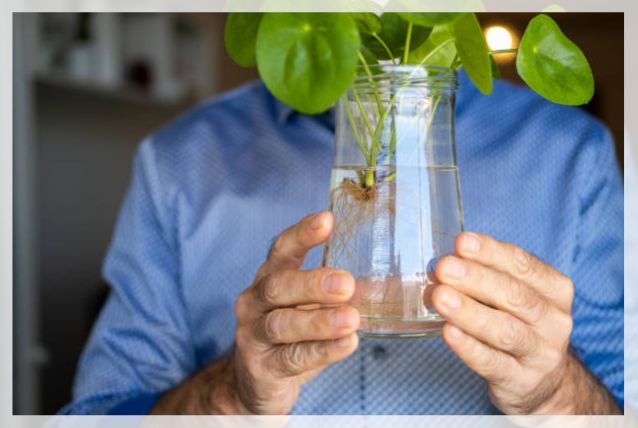
Do you know that there are different ways to propagate a plant and stem plant stem cutting is one of them?
Just like a lot of people, you will be familiar with the process of growing plants from seeds.
However, you can also have new plants by cutting off a portion of an established plant.
This is “cutting” that you place in an environment that helps to encourage that plant to produce new roots and/or stems.
Therefore, forming a new independent plant.
Propagating through plant stem cutting is like a form of cloning as the new plant will be an exact genetic match to the parent plant.
However, that is not always the case with other ways of propagating plants like collecting seeds, germinating, and planting them.
A lot of hybrid plants tend to produce seeds that do not “grow true” to the parent plant.
Thus rooting stem cuttings is the most reliable way to propagate hybrid plants.
How? Keep on reading.
Benefits of Plant Stem Cuttings
There are a number of benefits of plant stem cuttings.
Let’s discuss them as follows:
The new plant will just be like the parent plant.
For instance, if you variegated the parent plant foliage, the new plant that grows from the cutting will have the same foliage.
Moreover, if the parent plant is female.
Then propagating a plant by cutting will allow you to keep the special characteristics of that plant.

Plants that you grow from seed will often be different from the parent plant and from each other.
Propagating a new plant through cuttings will help avoid the difficulties of propagating by seed.
For instance, by using cuttings, you can propagate a young tree that has not yet flowered.
Thus has not produced seeds.
A male tree or a sterile plant like a navel orange.
Furthermore, some seeds can be difficult to germinate, taking two to three years for the seedling to appear.
A new plant that you grow from a cutting often matures faster and flowers sooner than a plant you grow from seed.
Learn more about What is Humidity and its Importance here.
Types of Cuttings
It is important to note that you can make cuttings from any part of the plant.
In most cases, however, you will use either the stem or leaf of the plant.
A stem cutting will include a piece of the stem as well as any attached leaves or buds.
Therefore, stem cuttings will only need to form new roots to be a completely independent plant.
While a leaf cutting uses just the leaf of the plant, so both new roots and new roots will form in order to create a new plant.
Stem cuttings: You can take plant stem cuttings from both herbaceous plants.
For instance, garden flowers and houseplants, and woody trees and shrubs.
As new growth of the trees and shrubs tend to harden as the summer begins, cuttings that you take at different times of the year vary in their ability to form roots.
Moreover, both softwood and herbaceous cuttings are likely to develop roots and become independent plants.
While hardwood cuttings are least likely.
Herbaceous: You can take cuttings from these plants at any time the plant is actively growing
Softwood: You will need to prepare cuttings from the soft, succulent new growth of the woody plants as it begins to harden
While shoots at the softwood stage will snap easily when you bend them.
The youngest leaves have not reached their mature size yet.
Semi-Hardwood: You can take cuttings from the growth of the current season after the wood matures.
The wood will be firm and all leaves will be full-size.
This often occurs in mid-July to early fall for the most plant while many broadleaf evergreens can be propagated through this process
Hardwood: You can prepare cuttings from shoots that grow from the last summer.
Moreover, you will cut them in winter or early spring while the plant is still dormant.
The wood will be firm and will not bend easily, while some deciduous shrubs and needled evergreens tend to root from hardwood cuttings.
Leaf Cuttings: You can prepare them by taking a single leaf from the plant.
It is important to note that the leaf must not only generate new roots but new shoots as well.
Moreover, the leaf you will use for propagation often does not become part of the new plant.
But disintegrates after the new plant forms.
Only a limited number of plants have the ability to produce new roots and shoots from a lead alone.
Root Cuttings: When you take a cutting from roots, you can also use them but only a few species can be propagated this way.
Cuttings that you take when the plant is dormant and the roots tend to contain the most energy stored.
Each root will produce. two to three new stems and each stem will produce its own roots.
While the original root cutting will disintegrate.
Learn more about Garden Landscaping Dubai: An Overview here.
When to take Plant Stem Cuttings
It is important to note that you can take and root plant stem cuttings at any time.
However, the technique tends to be more successful when the plant is not in full bloom.
When you intend to propagate outdoor garden plants over winter, you can take cutting after the bloom period is over in fall.
Or you can trim off any flowers or flower buds from the stem you are snipping off.

Moreover, stem cuttings that contain either a flower or flower bud are putting too much energy into the flower production, to allow for good root development.
It is important to note that if you are using shrubs or other woody plants, rooting via stem cuttings is likely to be successful if you take cuttings from the new growth.
These new growths should be the one that has not yet become woody.
Furthermore, with the help of a rooting hormone that you should use when attempting to root cuttings from woody plants.
Before Beginning
Every plant species has an ideal type of potting mix that tends to work well for its cuttings.
For a number of plants, an ordinary commercial potting mix that consists of peat moss tends to work fine.
However, other plant species tend to root best in a more porous mix, like:
- vermiculite,
- sand,
- seed starter mix,
- cactus/succulent mix,
- or some mixture of these ingredients.
It is important to note that you should never use ordinary garden soil to root your cuttings.
It is always best to use a sterile “soil-less” growing medium.
This is because it will be free of soil pathogens that can ruin your attempt to propagate.
You can also do a little bit of research on any plant you intend to propagate from stem cuttings.
It is easy to learn what experts recommend as the best growing medium that you can use for propagation.
What you will need for Plant Stem Cuttings
Things that you will need from plant stem cuttings are:
Equipment or tools you will need:
- sharp knife
- scissors
- or pruners
- small trowel
- pencil or sharp stick
The materials you will need are:
- soilless potting mix
- planting tray or small pots
- the rooting hormone which is optional
Follow the steps below:
Step 1: Take Cuttings from a Healthy Plant
During this step, you will need to make a cut of about 3 to 6 inches long from a healthy portion of the parent plant’s stem.
Do this with the help of a sharp knife or pruners to cut the stem at a 50-degree angle.
This angle cut will help to maximize the area available for roots to develop.
If possible, take a cutting from the newest growth on your plant.

Moreover, it is important to note that each cutting should have at least two to three sets of leaves along its length.
Make sure that the cutting also includes at least one growth node which is a bump on the stem from which leaves or flowers sprout that you can bury in the growing medium.
Roots will sprout from this node, as well as from the cut end of the stem.
It is important to note that it is not uncommon for some attempts at propagation to fail.
So it is best to take at least three cuttings to make sure you are successful.
Furthermore, woody plants can be particularly temperamental, so taking six or more cuttings is a good idea.
Step 2: Trim the Leaves and Apply Rooting Hormone
During this step, you will need to remove the leaves from the bottom node of the stem cutting.
In most cases, you can simply snap off the leaves.
However, make sure to retain at least three to four leaves on the stem cutting.
As an optional step, you can apply a powdered or gel rooting hormone to the trimmed end of the cutting and to the area from which you remove the leaves.
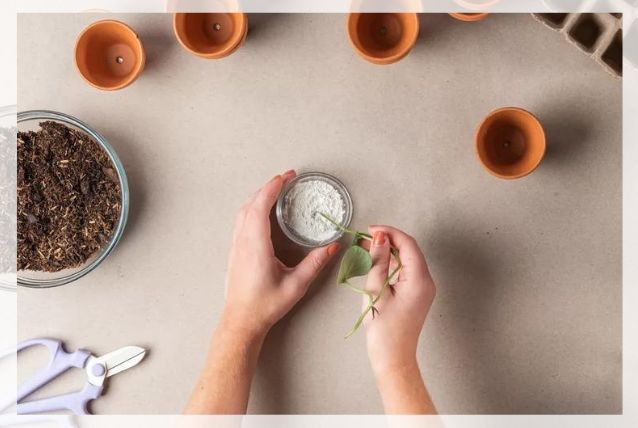
It is important to note that a lot of plants will root successfully from cuttings without the use of rooting hormone
However, using hormones can speed up the process and it also is necessary for some hard-to-propagate pants.
In case you choose to use a powdered hormone, it can help to moisten the stem before rolling in the powder.
While if you are using a gel hormone, you will simply need to dip the end of the cutting into the hormone.
Step 3: Plant the Cuttings
In this step, you will need to prepare a planting tray or small pots with a soilless potting medium like a seed-starter mix or vermiculite.
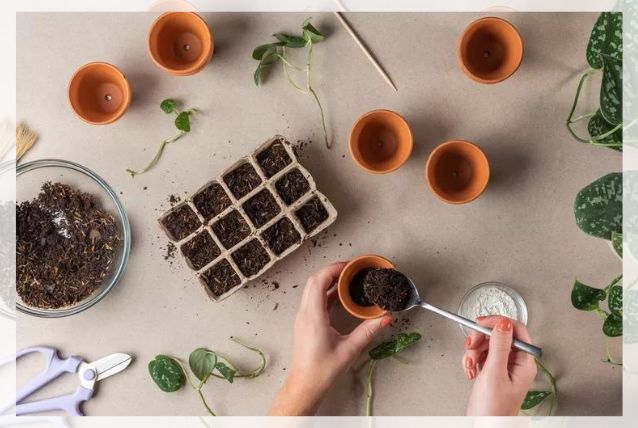
Poke a hole in the medium with a pencil.
Then place the end of each cutting into the growing medium and lightly tamp the mix around the stem of the cutting to hold it upright.
Step 4: Tend the Cuttings
It is important to note that most plants will not root well in full sun.
So place them in a location where they tend to receive a 50/50 ration of shade to dappled sunlight.
In most cases, cuttings tend to thrive on warmth and humidity.
And you will need to keep the growing medium evenly moist but not drench it in the water while roots develop.
Make sure to inspect the cuttings every two weeks, looking for new leaf growth and root development.
If flower buds or blooms tend to develop, make sure to pinch them off.
New leaves with assist with root growth, however, flowers will divert the energy away from root development.

Moreover, some plant species will require special treatment in order to root their cuttings.
For instance, the recommendation for some tropical plants may be to place the pot and cutting in a loosely tied plastic bag to increase the humidity level.
Or you will need to place warmth-loving plants or cuttings in a warm place or on a heating mat, during the rooting process.
Experts recommend that you should always research the particular needs of the plant species you are trying to propagate.
Step 5: Transfer the Cuttings
When you notice that new leaf growth is developing along the stem of the cutting, it means that healthy new roots are established.
Once you feel resistance when tugging on the cutting slightly it means the that roots are sufficiently developed.
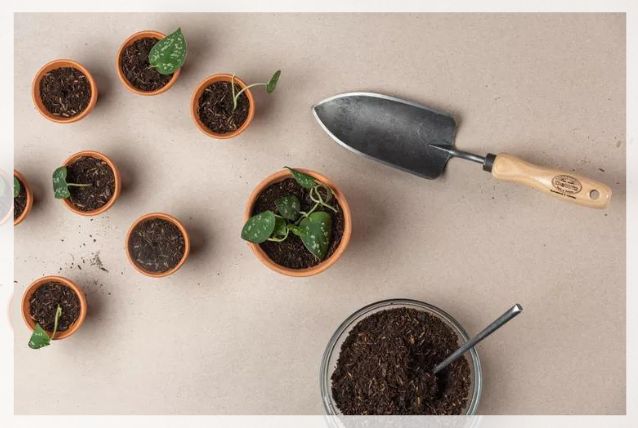
After this, you can now transfer the cuttings to a new pot with fresh potting soil.
With a small trowel or large kitchen spoon, you can scoop out the rooted cutting and transfer it to its new pot.
Moving Plants Outdoors
When you want to want to move new plants from plant stem cuttings outdoors, it is important to gradually acclimate them to outdoor conditions.
This process is called hardening off.
During this process, you will give the new specimen increasingly longer exposure to the outdoors over a period of one to two weeks.
Then you will set the plants outside for one to two hours only for the first few days and gradually increase the time exposure.
Moreover, place the plants during the warmer part of the day, but bring them indoors during cool nights.
Gradually, your plant will become accustomed to the outdoor environment.
Once the nighttime temperatures are reliably at 50 degrees Fahrenheit or warmer at night, you can plant your new plant in the garden.

Leave a Reply