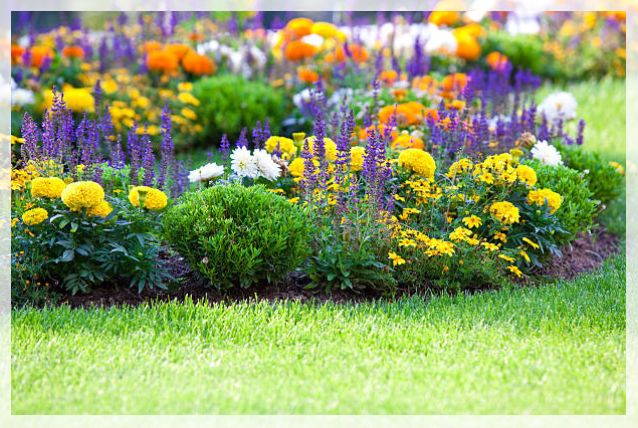
If you are looking for an opportunity to add color and creativity to your garden, you can choose to have a flower border.
Flower borders will make your garden an inviting oasis all year round.
Moreover, you can use these borders to show off a collection of showstopping flowers and foliage, create separate zones, and define your pathways.
Whether your garden ideas are greatly landscaped or wild and free, your garden borders will reflect and work in correspondence with the rest of your garden.
When planting these garden borders, you will need to consider the natural layout of the garden,
Look at which parts of your garden tend to get more shade and sun, how sheltered or exposed they are, and how wet or dry the area is.
This will affect which plants can grow best in your garden and where in the garden you can place them.
Keep on reading.
Flower Border
According to experts, there are a number of reasons why a lot of people may want to add borders to their gardens.
Garden borders can be a great way for you can highlight a specific area of your garden and make the layout visually appealing.
Moreover, you will commonly use them to separate areas, for instance, by keeping flowers and grass apart.
Another reason is to enable privacy within the garden, which includes birds and wildlife that might be looking for shelter from predators or to breed/nest during winter months.
It is important to note that even the smallest garden border tends to provide clearly defined rooms and give a clear framework for your garden furniture.
Learn more about How to Design Soft Landscape Works? here.
Garden Border Ideas
While planning your garden layout ideas, you will need to consider the color palette or the theme you want for your garden.
An easy way to create harmony within the border is to use repetition to create a clear and distinctive border.
While for a contrasting look that does not clash, you can look at the color wheel and pair together opposite colors.
For a more minimalist approach, you can choose varying shades of the same color.
Another way to add interest to your garden border is to mix up the shapes of the plants and flowers.
If you intend to have a stylish border however you are not most green-fingered, there are low-maintenance options you can choose from.
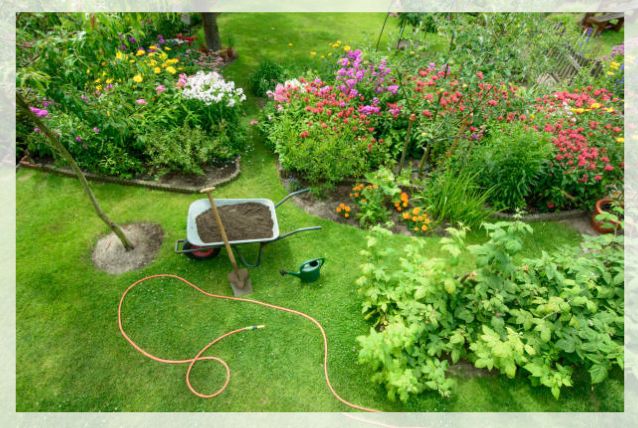
You can limit the number of plants that will need regular watering, feeding, clipping, or deadheading.
Instead, you can opt for plants like shrubs, evergreens, grasses, and perennials that will take care of themselves.
It is important to note that garden borders are full of potential and create stunning focal and interest points in your garden.
Moreover, it is always a good idea to plant shrubs or flowers that will grow taller towards the back of the border.
This will help to make sure that the smaller plants can be seen in front.
Let’s dive into small flower border ideas you can try today:
Border for Spring: Grape Hyacinths and Yellow Alyssum
For a flower border in spring, you can choose to have yellow alyssum.
You can use creeping phlox for your flowering ground cover plant.
It tends to be a bright yellow color that contrasts strikingly with fragrant grape hyacinths.
However, it is important to note that yellow alyssum is a bad-smelling flower.
If you are not that concerned about its fragrance, you can have yellow alyssum.
It will surely wow you with its color and beauty.
Summer Border: Patriotic Combos for American Gardeners
This one is for American gardeners.
It is a popular idea to create a summer flower border and use red, white, and blue flowers.
Moreover, these displays are often composed, at least in part, of annual flowers.
Annuals tend to be inexpensive bedding plants that allow you to plant an impressive display without breaking the bank.
And if you want all of the plants to be in bloom at the same time, like around July 4th, make sure to choose plants that tend to bloom in unison.
In such a patriotic border, you can achieve red with geraniums, white with annual alyssum, and blue with blue ageratum.
However, you can also choose to use:
- red salvia for red color
- Shasta daisy for white color
- victoria blue salvia for blue color
Fall Border: Autumn Joy Sedum
For fall displays, you can have an autumn joy sedum that is a late bloomer.
A long blooming perennial, when planting it, it helps assure continuous garden color from late summer until the first hard frost.
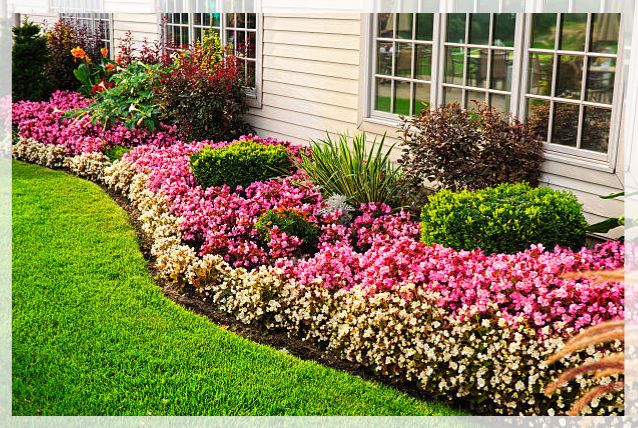
In such a garden, the autumn joy sedan is complemented by ‘Silver Dust’ dusty miller, among other plants.
It is important to note that dusty miller is a common choice when you ant silver foliage in your garden.
The brightness of its frost, white fronts tends to soften the design that is otherwise dominated by the dusky-pink tones of the Autumn Joy sedum.
Foliage for Times between Blooming Periods
It is not always ‘prime time’ for a certain flower border.
In case you want four-season interest in your landscape, the key is to plant a flower bed with just as much of an eye for foliage as for flowers.
In such a garden, you can have a ‘Purple Fountain’ beach tree that provides a background to the golden type of creeping jenny ground cover in the foreground.
Moreover, this type of flower bed will also show a pleasing variation in texture.
For instance, while the creeping jenny tends to have leaves with a fine texture, the presentation of the hosta plants behind them will be coarser.
The Perfect Flower Garden Border
With this flower garden border, you can pull out all the stops with multiple components to keep the viewer interested.
Along with perennials, it tends to exhibit:
- annual plants
- pachysandra
- evergreen shrubs
- yard art
- cobblestone edging
- a wood fence

The annuals, like marigolds, will help brighten the composition and provide a long-lasting color for little money.
While the pachysandra ground cover will furnish a nice, solid-green background and keep the flower border from looking too busy.
At the same time, the evergreen shrubs will provide a different plant form when they are globe-shaped, from the rest of the vegetation.
The softscape will begin to tell the story of this flower garden border as the hardscape will complement the planting.
Moreover, the yard art will serve as a focal point, while the fence breaks up the planting into more easily digestible segments.
Finally, you can notice the effect of cobblestone driveway paths that are lined along the edge.
One of the functions of garden edging or lawn edging is to frame a display area.
With the help of cobblestones, you can achieve that and even more.
Its appearance is rustic enough to retain an informality akin to its border.
Ornamental Grass
These grasses can plant a role in your flower border.
Tall or medium-sized grasses will help elevate the focus of the viewer.
They will help furnish variation in plant forms, and add motion and sound when bleeze tends to blow.
Moreover, ornamental grasses that are tall to intermediate in height tend to work well in flower beds as they do not overwhelm other plants.

You can choose to have:
- maiden grass
- zebra grass
- purple fountain grass
A Border focused on Foliage, Form, and Texture
You can spice up your flower border considerably with the help of different textures and plant forms.
The two bright red flowers in the garden, for instance, can be ‘love-lies bleeding’ and coleus.
Coleus tends to be an annual foliage plant that is indispensable for gardeners looking to experiment with color combinations in planting beds.
Moreover, it is a classic shade plant, though many types will do just fine in bright sunlight as long as they receive enough water.
To the right of the love-lies-bleeding and the red coleus, you can plant with the airy foliage that is the cosmos.
Their feathery leaves contrast nicely with the rest of the flower border.
Castor Bean plants in a Flower Border
You can plant this spectacular plant in the middle of the flower bed with its red stems and deep burgundy leaves is a castor bean plant.
This is a stunning example of how much a foliage plant can do to spice up a planting.
Moreover, this type of castor bean plant that has such dark leaves can be categorized as one of the so-called ‘black plants’.

As such, it is a beautiful color contrast with brighter plants.
However, it is important to note that castor bean plants are toxic.
So they may not be the best plant to have growing in your yard if children will be playing there.
Maintaining Scale
This large flower border with black-eyed Susans will help show the principle of proper scale.
If you can imagine a much smaller flower border in the front of your home, you can see how it would be swallowed up by its surroundings.
Moreover, a house and landscape of such a large measure will need a flower border sized to match.
The same works the other way around.
Aesthetically speaking, smaller trees for one-story homes are often the most appropriate choice.
Layered Flower Borders
Layered borders will have rows or ranks.
A layered perennial planting tends to feature tall perennials in the back row and short perennials up front, with medium-sized plants growing in between.
Moreover, in some cases, designers stray from this regimen for effect.
This is because when a relatively tall plant is placed in the front row to make a strong statement.
From a practical standpoint, layering will help make sure that are shortest plants are not deprived of sufficient sunlight.
You can also layer for aesthetic reasons, so that you can arrange the plants in the most pleasing composition, especially for the primary viewing angle.
Petunia Flower Border
If you think that your plantings often have to be complex to make a big splash, think again.
For a petunia flower bed, you will need no help from other types of plants to dazzle the onlooker with stunning color.
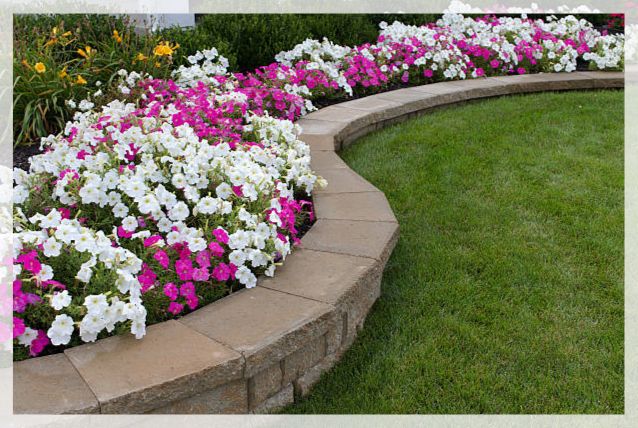
The border also employs some clever tricks to suit its urban location:
- the ground display can be supplemented by window boxed
- varying color of petunias provides more interest than using one solid color
- the plants are ground level are growing in containers though the containers are well hidden, so at first, you may think there are growing in the ground
Catmint and Tubs of Petunias
You can use catmint for flower borders.
These will make a pretty border.
However, they can lack pizazz if you leave them on their own.
In this example, catmint can get some help from tubs of petunias.
The containers are not disguised and rightly so, the ceramic tubs will look stunning and gorgeous.
Learn more about Petunia Flower: Care and Growth here.
Begonias used as Edging Plants
In some cases, flower borders can take the form of flowering edging plants.
In such an idea, you can have begonias, begonia x semperflorens-cultorum to create a colorful ring of altering red and white flowers around a shrub bed.

Leave a Reply