Plantation Farming in the Gulf Region: A Comprehensive Guide
Plantation farming involves the large-scale commercial cultivation of specific crops, often focusing on a single high-value commodity over extensive land areas. Historically associated with tropical cash crops like rubber or tea, plantation agriculture seeks to maximize yields and profits through intensive inputs and mechanization. In the arid Gulf environment – including the United Arab Emirates (UAE) and other GCC countries – plantation farming faces unique challenges such as water scarcity and harsh climate. Yet driven by food security and export goals, the Gulf states are increasingly supporting plantation-style agriculture.
Table of Contents
- History and Economic Role of Plantation Farming in the Gulf
- What is Plantation Farming?
- Common Plantation Crops in the UAE and GCC
- Environmental and Social Impacts
- Sustainable Plantation Practices in Arid Regions
- Labor and Capital Considerations in GCC Plantations
- Government Policy and Regulation
- Challenges and Opportunities in Modern Plantation Farming
- Conclusion
History and Economic Role of Plantation Farming in the Gulf
Historically, the Gulf region’s agriculture centered on small-scale oasis farming and pastoralism. Traditional plantations consisted of date palm groves irrigated by ancient falaj (gravity) systems. With the discovery of oil and surging government revenues, Gulf states sought to diversify by developing domestic agriculture. In the UAE, this meant building research stations and experimental farms. For example, Abu Dhabi established the Arid Lands Research Centre on Saadiyat Island, and Ras Al Khaimah set up the Digdagga Agricultural Research Station in Dibba. These initiatives aimed to encourage local Bedouin communities to adopt settled farming practices.
Over time, commercial fruit and vegetable production expanded. Official data show that roughly 81,000 hectares (about 200,000 acres) of UAE land are arable, with about 24% of cultivated land devoted to vegetables and 30% to fruits. Key agricultural areas like Ra’s al-Khaimah benefit from higher rainfall and mountain aquifers; its main crops now include tomatoes, melons and dates. Nationwide, the UAE produced over 1 million tons of vegetables and 360,000 tons of fruit in the 1990s. By the late 2010s, the country was meeting roughly 60% of its domestic demand for fruits and vegetables. Much of this growth was driven by government support: subsidies for irrigation, inputs and research bolstered agricultural yields.
Regionally, Gulf economies have also pursued food security via overseas farming. For example, Emirati firms like the International Holding Company (IHC) and Jenaan have leased tens of thousands of hectares in Sudan to grow grains, livestock feed and other crops. While these foreign farms are not in the Gulf, they highlight how Gulf countries use global land assets for agriculture. Within the Gulf itself, large-scale plantation farming remains limited by water and land scarcity. Instead, plantations focus on high-value crops (fruit trees and date palms) that justify the intensive inputs and infrastructure.
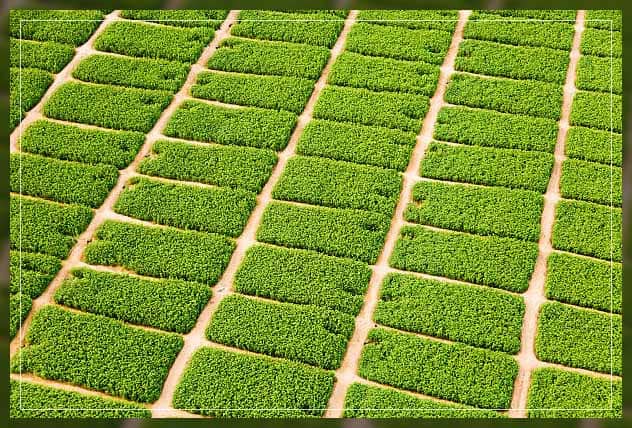
What Is Plantation Farming? Plantation farming is a commercial agricultural system that concentrates on the cultivation of a single crop (monoculture) on a large scale, using intensive inputs of capital, labor and modern technology
aaaksc.com
. It differs from subsistence farming in that the crops are primarily grown for sale and processing rather than for local consumption. Plantation farms typically require vast contiguous land areas, sophisticated machinery, and specialized management. In the Gulf context, plantations often consist of orchards or groves of perennial crops (e.g. date palms or fruit trees) rather than annual grains. They rely heavily on irrigation and mechanization to overcome the harsh climate. For example, a date palm plantation may include on-site packing facilities or processing units for date syrup. Plantation farming is inherently long-term and usually integrated with related industries to ensure profitability, tying the farm directly to domestic or export supply chains.
In practice, plantation farming’s defining features include specialization (often one or few cash crops), labor intensity, and capital intensity. Gulf plantation operators must invest in wells, pumps, fences and irrigation systems. They also need a reliable workforce for planting, pruning and harvest. Many Gulf plantations are linked to agro-industrial facilities – for instance, a date farm may own its own packing plant or collaborate with a processing company. By covering the entire supply chain, plantation farming aims to maximize value from each crop. Despite its challenges, this model can be profitable when a high-value or export-oriented crop is chosen and modern techniques are used consistently.
Common Plantation Crops in the UAE and GCC
The Gulf’s climate supports a surprising variety of plantation crops when irrigation is provided. Key commodity crops include the following:
- Date Palms (Phoenix dactylifera): The quintessential Gulf plantation crop. Date palms thrive in hot, arid conditions and have been cultivated in oases for millennia. Today, the UAE and Saudi Arabia account for a significant share of world date production. The UAE alone produced about 323,000 tons of dates in 2019 (roughly 6% of global output). Millions of date trees are planted across government and private groves. Many date plantations also process fruit into products like date paste and fiber. These palms tolerate saline soils better than most crops, making them well-suited to some UAE sites.
- Mango (Mangifera indica): Once uncommon, mango plantations have expanded rapidly, especially in the northern Emirates. Fujairah’s Hajar Mountains now host lush mango orchards (over 20 varieties), making it the region’s leading mango producer. Mangoes now account for roughly 4.6% of Fujairah’s fruit production (worth about Dh13.4 million per year), second only to dates. Other Gulf locations like Ras al-Khaimah and Al Ain also grow mangoes commercially. Mango plantations in the Gulf focus on high-yield cultivars that fruit earlier than traditional varieties, helping local growers capitalize on premium prices.
- Other Tropical Fruits: Farmers in the UAE have begun growing other tropical fruits suited to local microclimates. These include papayas and bananas in humid pockets such as the wadis of Fujairah. Citrus trees (oranges, lemons, limes, grapefruit) are cultivated in coastal plantations and intercropped with vegetables. Dates remain the top crop overall, but where soil and water conditions allow, orchards of pomegranates, guavas, figs and even lychee are being tried. Such tropical orchards often require greenhouses or shade nets to reduce heat stress on plants.
- Vegetables and Melons: Large irrigated fields of vegetables supply local markets year-round. Under the desert sun, crops like tomatoes, cucumbers, peppers, eggplants, lettuce and herbs are grown in open fields (in winter) or in greenhouses. Melons (watermelon, cantaloupe) are grown for summer. These plantations rely on drip irrigation to conserve water. In the 1990s, the UAE produced over 1 million tons of vegetables (including leafy greens and root crops). Most of this is consumed domestically, reducing imports of salad vegetables and melons. Many farms now use plastic mulches, shade houses and modern greenhouses to boost yields in hot months.
- Forage and Field Crops: Though less obvious, some Gulf plantations grow animal fodder (alfalfa, Rhodes grass, sorghum) under center-pivot or drip irrigation to support the dairy and livestock industry. The UAE once operated large state-run wheat farms; today, wheat and barley are mostly imported, but research continues on dryland cereals. Farmers rotate forage legume fields to regenerate soil nitrogen. Experimental trials have also looked at hardy crops like quinoa and barley for arid cultivation (the UAE does not rely on such grains yet).
- High-Value Specialty Crops: A growing niche is high-value produce and ornamental agriculture. Examples include organic herbs, spices, and flowers for export. The UAE grows roses and chrysanthemums in greenhouses for the European market. Date plantations increasingly brand “premium” and organic dates (e.g., Medjool and Khalas) for overseas sale. Some plantations cultivate medicinal plants like aloe vera or moringa for health products. These specialty crops leverage the Gulf’s image as a clean, desert-sun region and can command higher prices per hectare to offset costs.
Environmental and Social Impacts
Plantation farming can have major environmental consequences in fragile desert ecosystems. By definition, plantations require intensive water use. In the UAE, agriculture now uses about two-thirds of all freshwater withdrawals. Traditional irrigation can waste over 30% of water to evaporation, straining aquifers. Over-irrigation can even harm crops: UAE researchers found excess water causes nutrient leaching and damages date palm roots. Soil salinization is another concern: without proper drainage, salts accumulate in irrigated fields, reducing fertility.
Large monoculture plantations also affect biodiversity. Replacing native desert land with single-crop fields eliminates habitat for wildlife and can lead to pest outbreaks. Farmers often apply fertilizers and pesticides to maintain yields, which can pollute soil and groundwater if mismanaged. Socially, plantation agriculture is very labor-intensive. In the Gulf, most farm workers are foreign laborers recruited under temporary visa programs. Human rights observers note that these migrant workers – who form the vast majority of the UAE’s agricultural workforce – often face low wages and challenging living conditions. Ensuring safe, fair working conditions (shade, breaks, medical care) on plantations is an ongoing challenge.
In response to these concerns, some Gulf farms are adopting mitigation measures. Farmers plant rows of native windbreak trees around fields to reduce wind erosion and provide shade. Organic mulches and cover crops improve soil structure and reduce fertilizer needs. Solar-powered pumps and renewable-energy panels are being piloted to lower the carbon footprint of irrigation and processing. Integrated pest management and organic farming practices are gaining ground. In this way, plantation projects aim to be more sustainable and resilient in the Gulf’s environment.
Sustainable Plantation Practices in Arid Regions
Given environmental constraints, sustainability is critical for Gulf plantations. Advanced irrigation techniques are key: adopting micro-irrigation (drip or subsurface) can cut water use by over one-third compared to traditional methods. Many UAE farms have shifted from flood or sprinkler irrigation to drip systems to reduce evaporation. Precision watering (using soil moisture sensors) and scheduling (water during cooler hours) further conserve water. In some areas, treated wastewater is used for irrigation: drought- and salt-tolerant crops like date palms, Rhodes grass or engineered halophyte forages are irrigated with brackish or recycled water, preserving fresh aquifers.
Crop management also supports sustainability. Diversifying crops and rotating fields help maintain soil health. For example, farmers may alternate date plantations with legumes or green manure cover crops to replenish nitrogen. In organic farms, intercropping (e.g. vegetables grown among trees) and bio-pesticides (like neem oil) are used instead of chemicals. Mulching with crop residue conserves moisture and adds organic matter. By improving soil biology and structure, these methods reduce the need for chemical fertilizers and enhance resilience to drought.
Technology plays a big role too. Controlled-environment agriculture (CEA) — such as greenhouses, hydroponics and vertical farming — uses far less water than open fields. For instance, hydroponic greenhouses recirculate water, using up to 90% less than field crops. While CEA is usually associated with urban farms, Gulf plantations are adopting similar ideas: planting shade-net houses, greenhouse nurseries for seedlings, and indoor high-value crop production alongside outdoor orchards. This hybrid approach maximizes year-round output and protects against extreme weather. Together, these sustainable practices help Gulf plantations use scarce resources more efficiently while still being productive.
Labor and Capital Considerations in GCC Plantations
Plantation farming is inherently capital-intensive. Establishing a plantation requires major investment in land preparation, irrigation infrastructure, machinery and processing facilities. In the Gulf, many plantation projects are funded by governments or large corporations because individual farmers often lack resources. Joint ventures between local investors and international agribusinesses are common to share risks and expertise. Governments frequently subsidize part of the cost: for example, Abu Dhabi offers low-interest loans or matching grants for irrigation systems and wells. This institutional support is needed to cover the high upfront costs of plantation ventures.
Labor is the other critical input. Gulf plantations employ a large workforce for planting, maintenance, and especially harvesting. Most of these laborers come from South Asia or Africa under temporary work visas (the Kafala system). Their seasonal work allows plantations to function, but also raises social challenges. Migrant farmworkers often live in remote labor camps with minimal services. Ensuring humane conditions (cool drinking water, shaded rest areas, first aid) is increasingly emphasized by regulators. In some cases, Gulf governments have begun setting standards for farm labor accommodations and enforcing work-hour limits during the summer heat.
Mechanization is gradually reducing labor needs on Gulf plantations. Tractors, mechanical harvesters and even drones are being used on large farms. For example, some UAE date farms now use motorized pollination machines and GPS-guided irrigation to increase efficiency. This reduces dependence on manual labor but requires skilled technicians. As a result, plantation operations in the Gulf now balance labor-saving machinery with a smaller, more specialized workforce. Training programs for local youth are emerging to supply the skilled labor (technicians, agronomists) needed by modern plantations.
Government Policy and Regulation
Government policy is central to plantation farming in the Gulf. Land and water are strategic national resources, so states closely regulate them. In the UAE, all agricultural land remains government-owned; farmers obtain long-term leaseholds from emirate authorities in exchange for agreed-upon cultivation plans. Water rights require permits from agencies such as Abu Dhabi’s Environment Agency – Abu Dhabi (EAD) or Dubai’s water department. Farms must limit groundwater extraction to their licensed amount, which encourages efficient irrigation practices.
To promote plantations, Gulf governments also provide financial incentives. The UAE and Saudi Arabia have historically subsidized farm inputs (fertilizers, seeds, pesticides) and offered subsidized or free water up to a threshold. For example, Abu Dhabi’s farmers may receive free water for the first part of their irrigation quota. Emirati federal and emirate-level programs have funded over 50% of costs for greenhouse construction, drip systems, or desalination units on farms. The UAE’s Food Security Strategy 2051 sets targets for self-sufficiency in key crops and directs funding toward research on desert agriculture. Such support lowers the cost barrier for prospective plantation farmers.
Regulation also extends to quality and environment. Gulf plantations that export produce must meet international safety standards (e.g. GlobalGAP certification). The UAE encourages this through training and subsidies for certification fees. Environmental laws protect natural resources: for example, UAE Federal Law No. 24/1999 bans the cutting of native Ghaf trees and requires permits for any large-scale water extraction. Farms exceeding water allowances or depleting aquifers can face penalties. In recent years, environmental impact assessments have been mandated for very large irrigation projects. These policies aim to ensure that plantation expansion does not come at the expense of the Gulf’s fragile ecosystem.
Challenges and Opportunities in Modern Plantation Farming
Plantation farming in the Gulf faces significant challenges. The most critical is water scarcity. Even with efficient irrigation, the desert climate offers very little rainfall. Overpumping groundwater risks salinization and depletion of aquifers, which would undermine future farming. For instance, research shows many UAE date farms are currently using two to three times more water than palm trees actually require. Soil salinity and declining water tables are real threats if not managed carefully.
Economically, Gulf plantations must contend with high costs and market competition. Fuel, electricity and imported farm inputs are expensive. Planted crops must often compete against cheaper imports on price. As a result, Gulf plantations generally avoid low-value field crops and focus on niche markets (premium dates, organic produce) or crops with strategic value. Labor availability is another challenge: as other industries grow in the Gulf, keeping workers on farms becomes harder. To address this, governments offer incentives (e.g. subsidized housing, bonuses) to encourage nationals and expats to work in agriculture. Initiatives to train Emirati youth in agri-technology are also underway to build a skilled domestic workforce for modern farms.
Despite these hurdles, there are growing opportunities. Technology adoption is accelerating: Gulf plantations are using drones for crop monitoring, AI systems for irrigation scheduling, and genomics for developing heat-tolerant varieties. Vertical farming and hydroponics in urban areas complement outdoor plantations by boosting year-round output. The UAE and other Gulf states invest in agricultural R&D centers (like ICBA in Dubai) to adapt new crops and methods to the desert. Moreover, rising global demand for organic and sustainably-produced food can favor Gulf farms that brand their produce (e.g. “Emirati dates”) as eco-friendly. Gulf plantations can also diversify income through agro-tourism and value-added processing: some farms run visitor tours or market farm-branded products in city markets. Regional collaboration offers opportunity too – GCC countries share lessons on desalination, drip irrigation and crop adaptation, amplifying success. For instance, what is learned about mango farming in Fujairah can inform practices in neighboring Oman or Bahrain.
Overall, plantation farming in the Gulf holds potential to contribute to economic diversification and food security – provided it is managed wisely. Innovations in water saving, technology and crop selection continue to improve viability. By learning from both global best practices and local experiments, Gulf farmers and policymakers can expand plantations in ways that are both profitable and sustainable.
Conclusion
Plantation farming in the UAE and Gulf is a specialized form of agriculture shaped by the region’s climate and economics. From its roots in ancient oases to today’s tech-driven orchards and greenhouses, plantation agriculture has evolved alongside the Gulf’s development. Key insights include: choosing crops well-suited to arid conditions (e.g., date palms, salt-tolerant fruit trees); investing in efficient irrigation and soil management; and supporting farms with research and subsidies. Gulf plantations today must integrate modern techniques (like drip irrigation and renewable energy) and seek out high-value markets to be viable.
As the Gulf pursues greater food security, plantation farming will play an increasingly important role. Success will come from balancing productivity with conservation: saving water, protecting the environment and ensuring fair labor conditions. Stakeholders – farmers, agribusinesses, and government agencies – are encouraged to collaborate on innovation and sustainability. By embracing practices such as efficient water use, organic inputs, and climate-smart crop varieties, the UAE and its neighbors can build plantation agriculture that is both profitable and responsible. In this way, Gulf plantation farming can contribute to economic growth and food self-reliance, while preserving the unique desert environment for future generations.

Leave a Reply