
Growing a Coffee Tree Indoors or on the Patio: The Ultimate Guide to Coffea arabica
Most people experience coffee as a roasted bean ground into a morning ritual, yet the same plant that fuels cafés worldwide can be grown as a surprisingly forgiving houseplant. With glossy emerald leaves, jasmine-scented blossoms, and clusters of cherry-red fruit, the coffee tree (Coffea arabica) delivers tropical beauty long before you harvest and roast your own beans. This 3 600-word guide covers everything—light and soil chemistry, pot selection, pruning for productivity, pest troubleshooting, hand-pollination tricks, roasting basics, and even how to brew a “micro-lot” harvest. Whether you’re a first-time plant parent or a horticulture hobbyist keen on boutique espresso, you’ll find step-by-step instructions to keep a coffee plant thriving for decades.
Table of Contents
- Botanical Background & Quick Facts
- From Ethiopian Forests to Your Windowsill: A Short History
- Choosing the Perfect Location (Light, Humidity, Drafts)
- Soil Chemistry & Potting Mix Recipes
- Watering Schedule, Humidity Hacks, & Temperature Targets
- Fertiliser Calendar: Macro & Micro-Nutrients
- Pruning, Shaping & Bonsai Coffee
- Propagation 101: Seeds, Cuttings, & Air-Layering
- Getting Your Coffee to Bloom & Fruit Indoors
- Harvesting, Processing, & Home Roasting Your Beans
- Common Pests, Diseases & Organic Solutions
- Troubleshooting FAQs (leaf scorch, yellow tips, slow growth)
- Six Popular Coffea Species & Cultivars for the Home Grower
- Extra Perks: Air-Purifying, Sustainable Gifts, & Culinary Uses
1. Botanical Background & Quick Facts
| Common Name | Coffee plant, Arabian coffee |
| Botanical Name | Coffea arabica |
| Family | Rubiaceae (madder family) |
| Plant Type | Perennial evergreen shrub / small tree |
| Mature Size in Habitat | 15 ft × 15 ft (4.5 m) |
| Typical Indoor Size | 4–6 ft if pruned; dwarfs at 12 in. |
| Sun Exposure | Bright, indirect / dappled |
| Soil Type | Rich, moist, fast-draining, acid |
| Soil pH Target | 5.5 – 6.5 |
| Bloom Time | Spring to early summer |
| Fragrance | Sweet jasmine-like flowers |
| Hardiness Zones | USDA 9–11 outdoors; anywhere indoors |
| Native Range | Cool-mountain rainforests of southwestern Ethiopia |
| Toxicity | All parts except roasted seed are mildly toxic (caffeine & saponins) |

2. From Ethiopian Forests to Your Windowsill: A Short History
Coffee lore begins beneath the cloud forests of Kaffa, Ethiopia, where oral tradition tells of goatherd Kaldi noticing his flock’s midnight dance after chewing red cherries from a glossy shrub. Monks of the nearby Sufi monasteries brewed the berries to stay awake during prayer, and by the 15th century the beverage had spread across Yemen and the port of Mocha. Dutch traders smuggled seedlings to Java; French missionaries planted them in Martinique; eventually the “green gold rush” pushed coffee into every frost-free colony on the planet. Yet through centuries of selection, Coffea arabica remained a mountain understory species that dislikes harsh sun and water stress—traits that make it perfectly content on a humid windowsill.
The Victorians first popularised the coffee tree as a parlour specimen—botanical magazines from 1885 praised its “vigorous shine” and “agreeable perfume of star-white blossoms.” Modern indoor gardeners love it for similar reasons: shiny foliage, manageable height, and minimal pest pressure compared with fiddly tropicals like gardenia.

3. Choosing the Perfect Location
Sunlight Spectrum
- North-facing windows: safe year-round in hot climates; supplement with a 6 500 K LED grow bar in winter.
- East-facing: ideal morning rays; shield with sheer curtains if midday temps exceed 85 °F.
- South/West-facing: back up 2–3 ft or use a voile panel to avoid leaf scorch.
- Outdoor summer: set on a shaded patio (not full sun) once night temps stay above 60 °F.
Draft-Free Micro-Climate
Cold blasts from AC vents desiccate foliage; hot radiators parch roots. Aim for a stable 65 – 80 °F range. If your plant room drops below 55 °F at night, growth will stall and yellowing may appear.
Humidity Hacks
- Group calatheas, ferns, and coffee together to create a “humidity island.”
- Use a pebble tray with water just below pot level—evaporation raises RH by 5–10 %.
- Small desktop humidifiers run on distilled water prevent white mineral spots.
4. Soil Chemistry & Potting Mix Recipes
Coffee roots demand oxygen-rich but moisture-retentive media. Standard houseplant mixes often contain too much peat and not enough structure, leading to anaerobic pockets and root rot. Blend your own:
• 40 % high-quality peat moss (or coco pith, buffered)
• 25 % fine orchid bark (adds acidity & aeration)
• 20 % perlite #3 grade
• 10 % worm castings (slow nutrient release)
• 5 % crushed pumice or horticultural charcoal
This drains in under 45 seconds per litre yet holds capillary moisture. Top-dress with a tablespoon of elemental sulphur every six months if your tap water is alkaline (pH > 7.5).
5. Watering, Humidity & Temperature Targets
Moisture Meter Method
Insert a $10 moisture probe halfway into the root zone. Water when the reading dips from “Moist” into the upper edge of “Dry,” usually every 5–7 days in summer, 10–14 days in winter. Always use tepid water—cold shocks roots.
Self-Wicking Hack for Travellers
- Slide a ¼-inch cotton rope through the drainage hole before potting.
- Place the tail in a reservoir saucer.
- The plant will wick exactly what it needs for up to two weeks—perfect holiday insurance.
Ideal Climate Matrix
| Factor | Day | Night |
|---|---|---|
| Temperature | 70 – 80 °F (21 – 27 °C) | 65 – 70 °F (18 – 21 °C) |
| Relative Humidity | 50 – 70 % | 50 – 80 % |
| Leaf-wet hours | < 2 h (avoid fungal issues) | — |
6. Fertiliser Calendar
Coffee is a moderate nitrogen feeder. Too much N yields lush leaves at the expense of flowers; too little triggers chlorosis. Use a 3-part regimen:
- Early spring (March): ½-strength liquid 10-5-5 fish-emulsion + kelp to promote new flush.
- Late spring (May): granular citrus/avocado fertiliser 6-4-6 slow release, 1 tsp per 6 in pot.
- Mid-summer (August): foliar spray of 0.1 % iron chelate + 0.05 % magnesium to maintain deep green.
No fertiliser October–February while light is weakest.
7. Pruning, Shaping & Bonsai Coffee
In plantations, C. arabica is “topped” at 6 ft to ease harvest. Indoors you can mimic this:
- Pinch growing tip when plant hits 24 in; forces side branches.
- Maintain 4–5 main lateral scaffolds; remove crossing shoots to aid airflow.
- Lollipop notes: old wood rarely re-sprouts—make cuts on green stems < 6 mm wide.
Bonsai technique: Select dwarf ‘Nana’ or ‘C. liberica var. dewevrei’ seedling; pot in an 8-in shallow dish; prune roots by one-third each spring; wire branches while green. Mini coffee bonsai still bloom and set marble-sized cherries—perfect desk conversation piece.
8. Propagation 101
8.1 Seeds
- Use fresh unroasted “parchment” coffee (mailed from a green-bean supplier or harvested your own).
- Soak 24 h, then surface-sterilise 5 min in 1 % hydrogen peroxide.
- Sow flat-side down in sterile seedling mix; keep at 80 °F bottom heat, 100 % humidity dome.
- Germination: 45–60 days. Stage-one leaves (“split leaves”) appear before true leaves.
8.2 Cuttings
- Take 8–10 in softwood cutting with 2 nodes.
- Dip in 0.3 % IBA rooting gel; insert in 1:1 perlite/vermiculite under mist bench.
- Rooting success ≈ 50 % in 6 weeks.
8.3 Air-Layering
For clones that fruit sooner: girdle a pencil-thick internode, dust with rooting hormone, wrap with damp sphagnum + plastic, and within 8 weeks roots will fill the moss. Detach and pot up.
9. Getting Your Coffee to Bloom & Fruit Indoors
Coffee typically flowers when:
- The plant is at least 3 years old and 2 ft tall.
- Receives a dry-ish rest (soil merey damp, not soggy) for 6–8 weeks in late winter.
- Daytime temps hover 70–75 °F with relative humidity > 60 %.
Hand-Pollination
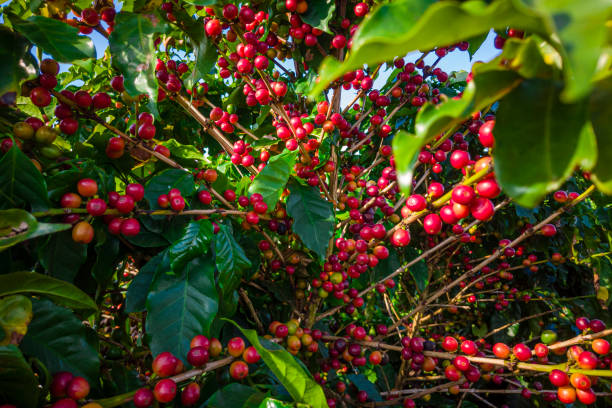
Coffee flowers are self-fertile, but gentle brushing with a small paint-brush ensures fruit set indoors. Within 7–9 months cherries ripen from green → yellow → red → deep crimson.
Yield Expectations
A 4-ft container plant can produce 30–40 cherries (~ 1.5 oz green beans) per year—enough for a single 10-cup Chemex brew. The thrill comes less from volume and more from tasting terroir you produced yourself.
10. Harvesting, Processing & Roasting
10.1 Picking
- Harvest only uniformly red cherries; green or partly red beans taste grassy.
- Twist gently—ripe fruit detaches easily.
10.2 Processing Methods
Wet / Washed Method (cleaner cup)
- Pulp cherries in a hand-crank depulper or squeeze between fingers.
- Ferment mucilage-covered beans in water 24 h (70 °F), stirring twice.
- Rinse until beans feel squeaky.
- Dry on a mesh screen to 11 % moisture (~ 7 days, < 120 °F shade).
- Hull parchment in a spice grinder (pulse) or mortar + pestle.
Natural / Dry Method (fruit-bomb sweetness)
- Spread entire cherries 1-bean deep on a screen.
- Dry 2–4 weeks, turning daily until rattling dry.
- Crumble husks by hand to release green beans.
10.3 Home Roasting Basics
You can roast 2 oz in a hot-air popcorn popper (1200 W) in 5–6 min:
- Pre-heat popper; add beans; agitate.
- First crack ~ 4 min (light city roast).
- Stop at desired colour; cool fast in colander.
Store roasted beans 24 h to de-gas, then grind and brew. Voilà—estate coffee from your living room!
11. Common Pests & Organic Solutions
| Pest / Disease | Symptoms | Treatment |
|---|---|---|
| Mealybugs | Cotton fluff at leaf axils | Q-tip dipped in 70 % alcohol; follow with neem 1 % |
| Spider mites in dry homes | Stippled leaves, fine webbing | Increase humidity; spray insecticidal soap every 3 days × 3 |
| Scale insects | Brown discs along stems | Scrape off; apply horticultural oil 2 % |
| Root rot (Pythium) | Wilting despite wet soil | Repot in fresh mix; drench with Trichoderma biofungicide |
| Leaf spot fungus | Brown rings on foliage | Remove affected leaves; space for airflow; copper fungicide if severe |

12. Troubleshooting FAQs
- Brown crispy edges
- Usually low humidity or excess fertiliser salt. Flush soil, raise RH, and trim damage.
- Yellow leaves dropping
- Over-watering or cold drafts. Check root health; allow top inch to dry; move away from AC vents.
- No flowers after 4 years
- Plant may be too shaded or nitrogen-overfed. Increase light to 200+ μmol m-2 s-1 and switch to 3-1-5 bloom fertiliser.
- Slow growth, pale new flush
- Iron deficiency on alkaline water. Apply chelated Fe-EDDHA drench; collect rainwater for irrigation.
13. Six Coffee Species & Cultivars Worth Trying
- Coffea arabica ‘Nana’: true dwarf, 12 – 18 in tall, fruits in 30 months.
- C. arabica ‘Bourbon’: heirloom cultivar with high cup score; compact nodes.
- C. arabica ‘Catuaí’: naturally small, heavy producer; ideal for container orchards.
- Coffea canephora (robusta): higher caffeine, larger leaves, tolerates warmer temps.
- C. liberica: almond-shaped beans; grows 30 ft but can be pruned; unique smoky notes.
- C. eugenioides: very low caffeine, sweet cup; collectors’ gem.
14. Extra Perks & Creative Uses
- Air purification: NASA Clean Air Study lists coffee among plants that remove formaldehyde.
- Compost booster: Spent coffee grounds are a nitrogen-rich “green” component.
- Edible cherries: The sweet pulp (cascara) makes refreshing tea or kombucha starter.
- Holiday gifts: Pot up rooted cuttings in 4-in terracotta, tie with twine, include a tasting note of your favourite single-origin brew.
- Botanical dyes: Boiled leaf prunings yield pale celadon dye for natural fabric projects.
Conclusion
The journey from glossy seedling to aromatic bean cup is longer than brewing an espresso, but for plant lovers it offers layered rewards: lush foliage all winter, sweet jasmine perfume in spring, ruby cherries in summer, and finally the sensory theatre of home roasting. By mimicking a misty Ethiopian understory—bright but filtered light, acidic humus-rich soil, steady moisture, and lofty humidity—anyone can turn a spare bedroom, office window, or heated greenhouse into a micro coffee estate. So next time you grind store-bought beans, save a few parchment seeds or order green beans online, gather a 6-inch pot, and start your own coffee story today.
Related guides: Using Peat Moss to Lower Soil pH • 15 Tropical Houseplants for Bright Rooms • Houseplants Safe vs. Toxic to Pets




Leave a Reply