
There are different types of cedar trees you can choose to plant in your garden.
True cedar belongs to the genus Cedrus, or Pinaceae family, and consists of four species.
The native area belongs to mountainous areas from the western Himalayas to the Mediterranean.
Moreover, their fragrant wood is priced for lumber, as it resists pests and rots.
However, people also use them as ornamental trees.
Furthermore, to identify cedar trees, you will notice that they have upright, barrel-shaped cones on them.
It is important to note that experts also use “cedar” to loosely include trees of other genera and even of other plant families.
Most of these are of the Cupressaceae family of evergreen conifers.
However, as true cedars will have short needles that tend to form clusters close to the branch.
The foliage of false cedar will be larger, scaly leaves that are awl-shaped or from fan-life sprays.
Keep on reading to learn more about a cedar tree in detail.
Quick Facts about Cedar Tree
Some quick facts about cedar trees are:
| Tree Type | Evergreen coniferous |
| Distribution | Southern and South-Eastern Mediterranean, Western Himalayas |
| Habitat | Mediterranean: 1,000-2,200 m Himalayas: 1,500-3,200 m |
| USDA Hardiness Zone | 2-9 |
| Growth Rate | Moderate to high |
| Lifespan | 100-150 years and some can live up to 300 years |
| Growing Conditions | Sunlight: Prefers full sun to partial shade Soil: Slightly burned or tilled, well-drained, moist Water: 1 inch per week in dry seasons |
| Drought Tolerance | Moderate |
| Reproductive System | Monoecious |
| Propagation | Through stem cuttings |
| Wildlife Value | Stems and roots of seedlings are consumed by the larvae of turnip moth and pine processionary; moreover, several bird and mammal species eat cedar berries |
Growing Cedar Tree
A cedar tree is not hard to grow and tends to have elegance in any space where they have room to spread.
The tree often starts from seeds, however, will need a 48-hour soaking period and another month in the refrigerator, along with some potting soil in a zip log bag.
Moreover, you will need to keep the soil moist during this time.
After a month, you can place the seeds in a paper cup with compost and potting soil mixture.

Then you will need to place the cups in a sunny window and keep the potting soil moist during this time.
Later you can plant the seeds outside in the ground when they are about 6 inches or 15 cm tall.
Furthermore, make sure to select a sunny spot and do not plant your trees closer than 5 feet or 1.5 m apart
Dig a hole that is about 3 times the size of the paper cup and make sure to always use high-quality compost and some native soil mix to fill the hole.
Lastly, llace about a 2-foot or 0.5m stake next to each growing tree, moreover, attach the seedling to it with the help of garden twine gently.
Identifying Cedars
To identify cedar, consider the following:
The height of the tree tends to be about 98 to 130 ft or in some cases, 197 feet. While the leaves of the plant are needle-like.
Moreover, its leaves are arranged in an open spiral form and are about 8 to 60 mm long.
The diameter of the trunk of the plant is about 8 to 10 feet or 2.5 to 3 meters.

Furthermore, tbark of cedars is square cracked or thick ridged, while it has cones that are barrel-shaped about 3 to 8 cm broad and 6 to 12 cm long.
About 10 to 15 mm long are its seeds with a wing size of about 20 to 30 mm.
When young, the crown of the tree tends to be conical, and when it fully grows, it is often broad and flat.
Moreover, pollen cones are slender and oval-shaped about 3 to 8cm long.
Popular Cedar Trees
Some popular true and false cedar are:
Deodar Cedar or Cedrus Deodara: Deodar, a weeping tree tends to have needles that are bluish-green or grayish-green.
A Himalayan native, deodar tends to thrive in deep soil that is evenly moist but well-draining.
The ideal soil for growing them is acidic loam soil and the plant tends to be drought-resistant once it establishes.
Moreover, it is native to the western Himalayas, 7 to 9 are USDA growing zones, it grows about 40 to 70 feet tall, and will need full sun exposure to grow.
Cedar of Lebanon or Cedrus libani: This one is native to the Middle East and tends to tolerate cold better than deodar.
The needles of this plant are dark green or gray-green and are a slow grower in late fall.
Moreover, this true cedar makes a good long-lasting shade tree and is native to Lebanon.
USDA growing zones are 5 to 9, it grows to about 40 to 100 feet tall, and will need full sun to grow.
Cyprus Cedar, or Cedrus brevifolia: This true cedar is a slow grower that develops into an umbrella-shaped crow.
And it gets its species mane from Latine, i.e. with short leaves.
Moreover, its needles form short clumps and branches tend to be shorter than those on other cedars.
Its needles are green to bluish-green are native to Cyprus, and USDA growing zones are 5 to 8.
Furthermore, it can grow to about 40 feet tall and will need full sun exposure for growth.
Atlas Cedar or Cedrus Atlantica: Give these true cedars well-draining, acidic soil and they will grow well.
When they are young, the habit of this species is loosely pyramidal and will become more flat-topped as it matures.
However, in landscaping, this weeping cultivator ‘Glauca Pedula’ is more famous and its maximum height is 12 feet.
Moreover, it grows in areas of Atlas mountains, North Africa, USDA growing zones are 6 o 9, 40 to 60 feet tall in height, and need full sun.

Incense Cedar or Calocedrus decurrens: This one is a false cedar and belongs to the Cupressaceae family.
The plant incense cedar in deep, fertile soil.
However, you will need to keep the soil moist but well-draining and plant them in a spot that is protected from drying winds.
Moreover, when you crush its foliage, it tends to be aromatic, hence its name.
Native to the western United States and Mexico, the USDA growing zones are 5 to 9, it grows to about 30 to 50 feet in height and will need full sun to partial shade.
Eastern Red Cedar, Juniper virginiana: One positive of growing them is they are fragrant, and will have a great reddish-brown break.
And will produce bluish, berry-like cones that draw birds.
Moreover, as a bonus, it is salt tolerant and extremely hardy. However, one downside is that a tree is invasive in some regions.
It is native to Eastern North America, USDA zones are 2 to 9, grows to about 30 feet tall, and will need full sun.
Northern White Cedar, Thuja occidentalis: Another false cedar, also known as “arborvitaes”.
This one is native to the northeastern U.S. and eastern Canada.
They are popular landscape plants, particularly for hedges, and come in a number of shapes and sizes.
Moreover, these range from small, globe-shaped oddities to more functional tall, and slim varieties.
Native area of this type is Eastern North America, hardiness zones are 2 to 7, grows to about 12 to 20 feet tall, and will need full sun to partial shade for growth.
Other Varieties
Some other popular varieties are:
Western Rd Cedar or Thuja plicata: Native arborvitae, grows in moist but well-drained soil with good fertility.
This Cupressaceae family member tends to tolerate neither tolerate nor hot summers.
Moreover, this one is a semi-dwarf tree with dense foliage of dark green with golden white tips.
It is native to the pacific northwest, USDA zones are 5 to 7, and grows to about 50 to 70 feet in height.
Port Orford Cedar or Chamaecyparis lawsoniana: You can grow this false cedar in moist but well-draining soil of average fertility, and forms a narrow pyramid as it grows.
Draw cultivators are available for both small and average size landscapes.
Moreover, it is native to Pacific Northwest, USDA zones are 5 to 8, can grow up to 200 feet in the wild, and will need full sun to partial shade.
Alaska Yellow Cedar or Xanthocyparis nootkatensis: Also popular as a “Nootka cypress”.
It is best known for its “Pendula” i.e. weeping and “Glauca Pendual” i.e. blue weeping cultivators.
Weeping blue Alaskan cedar or Xanthocyparis nootkatenisis, ‘Glauca Pendual is a small evergreen tree.
Moreover, it grows to about 10 feet in height after 5 years and 20 feet at maturity.
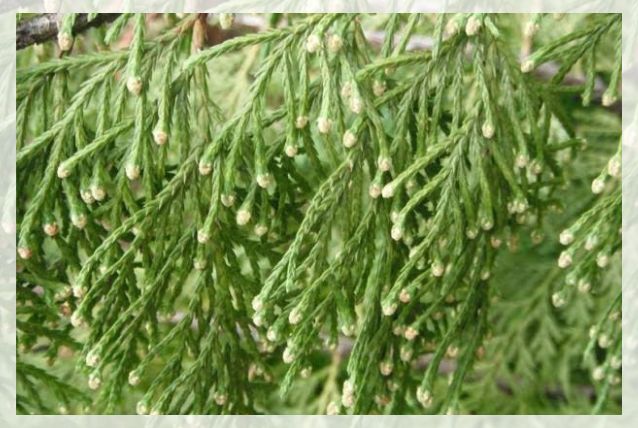
However, experts also refer to it as False cypress as not only is it not a true cedar, but it is also not a cypress as well.
Therefore, you can grow it in well-draining soil, native to Western North America, hardiness zones are 4 to 7, and will grow well in full sun.
Japanese Cedar or Cryptomeria Japonia: This is Japan’s national tree and many cultivators are suitable for average landscape, including compact types like ‘Globsoa Nana”.
The latter one is a slow grower that tops out at 4 to 8 feet while you will need to feed water regularly.
Moreover, it is native to Japan, USDA growing zones are 5 to 7, and will need full to partial sun for growth.
Common Problems
Though there are not too many cedar tree problems your tree may experience, some pest insects are, however, attracted to cedar trees.
These include:
- cypress tip moth
- root weevil
- mites
- juniper scale
Moreover, if your tree is infested, it will show symptoms like brown or yellow foliage, reduction of plant sap, white cocoons, or black, sooty mold.
With the help of horticultural oil or insecticide, you may need to treat the plant in case of extreme infestation.
Furthermore, dogs and pets also like cedar trees and will munch on their bark.
Therefore, this can cause excessive damage if you do not attend to this properly. Hence, with the help of proper diagnosis and treatment, you can prevent tree loss.


Leave a Reply