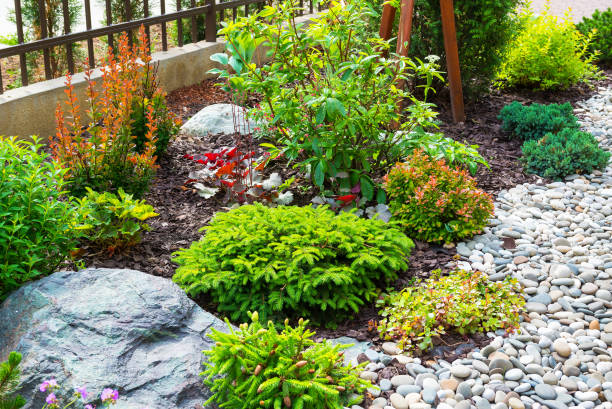
Do you feel your garden is missing some definition? Well, seems like you are missing a few hard landscape elements that can accentuate its look. One of these are landscaping rocks.
The best part is that these rocks or stones usually are naturally found and durable.
You will hardly need to maintain them once they are in your garden.
And let’s not forget it is pretty versatile so you can use it in many ways.
But what are these rocks?
Well, this article is here to help.
We discuss the different types of landscaping rocks and how you can choose between them.
Keep reading below to know more.
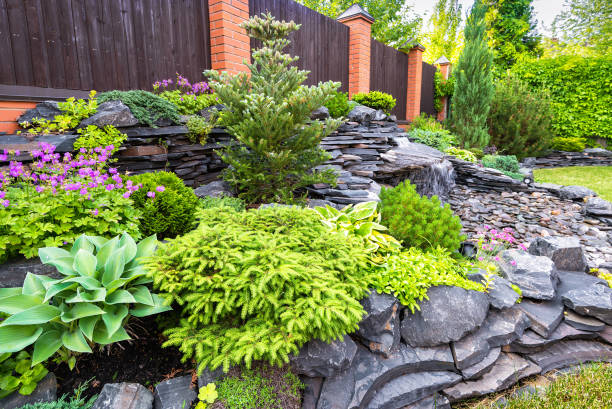
Considerations for Choosing Landscaping Rocks
Color
Have a look at your garden.
If you wish to give it a rock garden look, what will suit best with your lawn?
There are several choices when it comes to colors, hence you can match and contrast at will.
Keep a design in mind before you set out to purchase the stones.
Ease of Installation
Boulders surely look appealing in offices and outdoor settings but they can be hard to install in a DIY manner in your garden.
Therefore, the ease of use and installation is crucial to know what stones and rocks you can use.
In this case, you will have to hire a professional to help you with installing it using their equipment and their expertise.
However, if you prefer implementing your own design and gathering your own material, this will not be an ideal scenario for you.
Size
Smaller rocks provide better drainage.
Moreover, they have uses that large stones are unable to provide.
On the other hand, when it comes to the larger sized stones and rocks, they are good for stability.
Therefore, they can be used in structural elements such as a stone retaining wall.
Also look at the aesthetic of your garden.
Will larger rocks add to its appeal or smaller ones will make it standout?
Cost
It is impossible to leave the budget out when selecting the best stones and rocks for your landscaping ideas.
If you need rocks in a bigger quantity and size, those in beautiful colors may actually come quite expensive.
Thus, it isn’t a viable option.
For adding color, maintain your plants well.
Moreover, choose affordable rocks to place in your garden unless you want to splurge on a one-time expenditure on the garden.

Home garden at night, illuminated by globe shaped lights. Decorative gardening and landscaping abstract.
Types of Landscaping Rocks
River Rocks
These stones are found at the river beds.
Thanks to nature, they are rounded and smoothened.
So it is a smooth and symmetrical rock that is one of the most versatile among the options you have.
Thus, making them a good option for walkways as they will not hurt feet or shoes.
The river rocks are also good with the stone retaining walls, erosion control and flower beds.
These are also ideal for dry creek beds if you have a place where water pools.
Cobblestone
Cobblestone in your driveway aprons will take you back in time.
These exude a classic and traditional charm that will be enough for covering the apron while not spending entirely on the driveway.
However, one downside of using cobblestone is that these are expensive and rough.
The rough surface is uneven so it is hard to remove the snow.
Pebbles
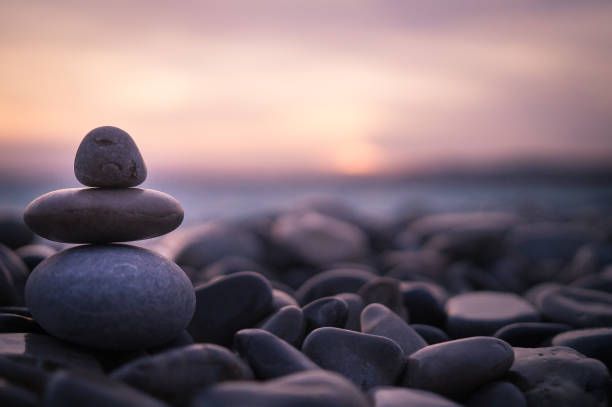
Mexican beach pebbles are round and smooth plus mostly available in various colors such as deep red, black and dark grey.
These especially suit types of xeriscape and plants such as cacti.
Black polished pebbles are easily available in many home décor stores.
You can try mixing these with white pebbles to give a B&W contrasting effect.
These are however expensive as some may have been tumble polished to add that extra shine.
The process of tumbling can take a few weeks to complete thus the pebbles are not cheap.
You can use these as a darker element in the lighter rocks in a dry creek bed to add color and contrast.
It can be mulch to edge the planting beds, patios and walkways.
Moreover, it can act as a filler in between plants that are not spread out in your garden rather are in containers in a container garden.
Big and Small Stones
Boulders
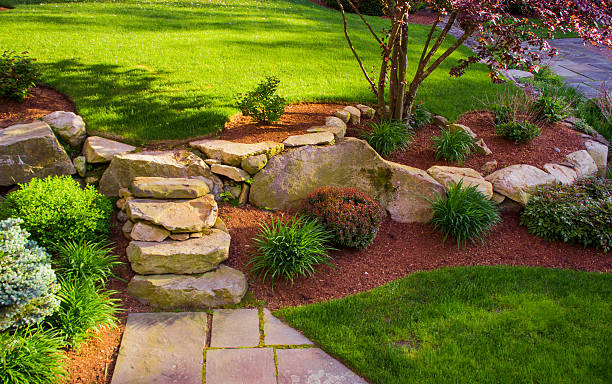
Usually boulders are rocks that measure around a foot or more in diameter and are heavy to lift.
It is best placed in terracing to add a presence and accent that is visible from distance.
Boulders can be irregularly shaped, rounded or have flat surfaces. The common thins is that they are big enough to make an impression from far.
It should however, be incorporated in the garden in natural way. Placing it as it is, will not do.
Thus, bury most of it, showing up only enough on the surface.
If the placement is correct, boulders may also help in retaining soil to be useful in terracing slight slope.
A stonecutter may further plumb it to use a center piece in a garden fountain.
Crushed Stone
Crushed stones act as mulch that are inorganic and will not decompose over time.
It is key in mulching around some plants and is also widely used for making a patch in the yard to keep the dog.
Though, it is also an underlayment of patios.
It is durable than other mulches and also requires less maintenance than grass in garden patches.
What’s more, it allows the water and oxygen to get into the soil.
Though, it is non organic, thus it will not release any nutrients.
Lava Rocks
You may know lava rocks by their distinct red color.
These especially look nice in a rock garden adding a pop of color to the landscape.
However, you can also find them in black.
Make your color selection according to the plant material in the garden as well as the overall aesthetic.
Moreover, theses rocks are best placed around fire pits.
These rocks tend to regulate temperatures and also retain water.
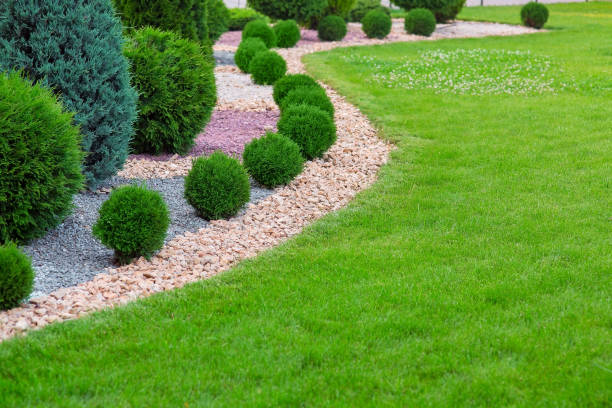
Landscaping Rocks to Know
- Flagstones: The big stone son the walkways and patios in between grass are the flagstones. It is a sedimentary rock which is flat and durable. Hence, it becomes a paving stone for people to walk onto. It is the best stone to use for formal walkways. Application requires a thin layer to even the ground completely and sink the stone in it, something you can do easily. so installing is not a huge task.
- Brick chips: Technically brick chips are not rocks but chips from broken bricks. Nonetheless, they are involved in making hard landscape at a cheaper rate. The striking red color can be painted into other different colors.
- Fieldstone: This stone is best used for stone retaining walls and making general stone walls. The stones are heavy and will give a lot of definition to an area by piling them up in a stone wall.
- Artificial Rocks: If you are exploring your options for landscaping, why not consider artificial rocks as well? These look real but are easy to move and last long enough. Moreover, they are used for hiding spots. These rocks are hollow so they provide cover from tree stumps and wellheads as well as parts of your yard.
- Pea Gravel: If you have any holes, pea gravel is best for filling it so that the place is safe for kids and pets. It is usually present in parks and public gardens with different shades of mixtures. Additionally, you will not need a thick layer of the gravel so it is cheap to use.
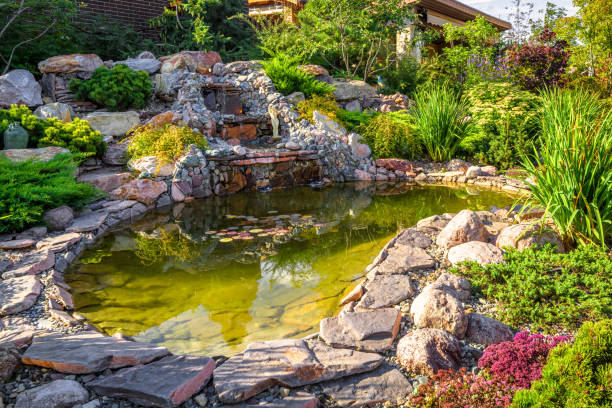
How to Use Them?
Single Path
Flat rocks such as flagstones make for the ideal stone to make a stone path.
Is there any place in your house that is hard to get through? Make a stone path through your garden to reach there.
You can also use crushed granite for the path.
It will make way while also looking seamlessly in nature.
Manmade Reservoirs
After doing a little excavation and by installing rocks you can make ponds that act as reservoirs.
This is not part of your garden but can be an efficient use of landscaping rocks to accentuate the look of your entire home.
Mixing and Matching
Do not necessarily go for one stone, rather create a more natural look by mixing them and matching according to the feel of your yard.
Try contrasting the different styles of rocks to achieve an ideal effect and to add a pop of color to the yard.
Mix dark rocks with light ones so there is not a uniform look but a more neutral and natural one.
Make Green Pop
In your garden, if the grass and greenery is your focus rather than the rocks, then increase its presence by putting some landscape rocks at the base of trees and plants.
The rocks do not have to be excessive rather they bring a natural effect to an already polished garden.
All the while remaining trendy.
You can also use these rocks in stone walls and patio designs. Align them with what you already have to add an earthy feel.
Summing Up,
Landscaping rocks are of several kinds.
Choose those that go well with your entire landscape and yard design.
If you do not want to install them yourself, contact Al Ardh Alkhadra for more information on soft and hard landscaping for your property.


Leave a Reply