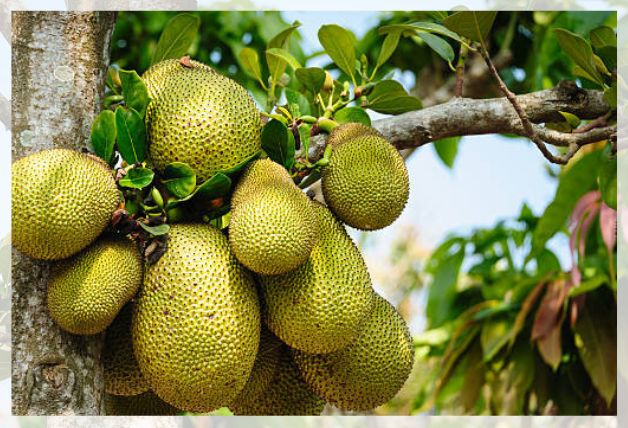
Do you know that the Jackfruit tree is a tropical tree that tends to grow edible fruits?
You can use the edible fruit from this tree as a meat substitute or dessert.
This tree is also known by its common name jack tree.
Moreover, it belongs the to Moraceae family which is relative to breadfruit, mulberry, and fig trees.
Jackfruit leaves tend to be dark green and glossy and the tree is monecious, which means it has both male flowers and female flowers on the same tree.
The jackfruit tree is native to Southwest India and can produce about 100 to 200 jackfruits a year.
This tree tends to grow well in the tropical climates of the Philippines, Thailand, Malaysia, and Bangladesh, where it is the national fruit.
Keep on reading to learn more
Jackfruit Tree
The tropical jackfruit tree, Artcarous heterophyllous is a large evergreen tree that tends to bear edible fruit.
This tree tends to have a relatively fast growth rate and a new tree will start to produce fruit within a few years.
Moreover, the best time to plant this tree is in spring and the tree trunk grows fairly straight and has reddish-brown bark.
From it extend large branches with glossy green leaves that are about 8 inches long.

The tree tends to produce showy green flowers mostly in the fall, though it can also bloom sporadically at other points in the year.
Its yellow-green, kidney bean-shaped fruits are huge that mature on the tree in the mid-summer
They average between 10 and 40 pounds though some fruits are known to weigh 80 pounds on more.
The inner yellow flesh is mildly sweet and many people compare it to bananas and pineapples.
Quick Facts about Jackfruit Tree
Some quick facts about the jackfruit tree are:
| Botanical Name | Artocarpus heterophyllus |
| Common Names | Jackfruit, jack tree |
| Plant Type | Tree |
| Mature Size | 30-70 ft. tall, 20-50 ft. wide |
| Sun Exposure | Full |
| Soil Type | Loamy, moist, well-drained |
| Soil pH | Acidic, neutral, alkaline |
| Bloom Time | Seasonal |
| Flower Color | Green |
| Hardiness Zones | 10-12 (USDA) |
| Native Area | Asia |
Jackfruit Tree Care
This tree is fairly easy to care for if you have the appropriate climate for them.
They will need ample light and warmth.
When you initially plant them, make sure to choose a young nursery tree with any signs of disease or distress.
Aim to find a nursery tree whose roots have not outgrown its container.
In case the roots of the young tree have been cramped, they may not grow normally even when you plant the tree in the ground.
This can impede the overall growth of the tree throughout the course of its life.
Make sure to select a planting site with some space for other trees and structures as this tree will ultimately grow quite large.

Moreover, it often will not do well when you transplant it when you need to move it to a more suitable planting site.
The key to growing jackfruit trees is to keep the soil evenly moist especially for the young tree as they establish their roots.
Make sure to regularly weed around your tree to prevent other plants from competing for nutrients and moisture in the soil.
Mulch around your tree, as it can help to suppress the weeds and retain soil moisture.
It can also help keep the roots warm if the temperature happens to dip.
Light and Soil Requirements
Jackfruit trees will need full sunlight to grow well and produce fruit.
This means that it should get at least 6 hours of direct sun on most days.
Moreover, a tree that you grow in conditions that are too shady is unable to bear fruit.
This tree prefers nutrient-rich soil with excellent drainage.
They are not overly picky about the soil pH though they seem to grow well in slightly acidic soil.
Water, Temperature, and other requirements
As tropical plants, jackfruit trees will like consistently moist soil year-round.
Make sure to water them whenever the soil begins to dry out due to the lack of rainfall or extreme heat.
However, make sure that the tree roots are not sitting in pooling water.
This can inhibit fruit production and kill the tree eventually.
Moreover, this tree tends to like warm temperatures and is very heat tolerant.
however, they tend to be sensitive to frost, especially young trees, and temperatures below 35 degrees Fahrenheit can easily weaken or kill them.
This tree prefers humid conditions and does not thrive in dry climates unless you can keep the soil very well watered.
Make sure to fertilize jackfruit twice a year in the spring and fall with a slow-release granular fertilizer.
It can also be helpful to mix compost into the soil around the tree annually.
Types of Jackfruit Tree
There are a number of varieties of jackfruit available. These include:
‘Black Gold’: This tree tends to produce a high yield of medium-sized fruit.
‘Gold Nugget’: This variety bears a high yield of relatively small fruits.
‘Dang Rasimi’: This variety tends to produce a very high yield of medium to large fruits.
‘Kun Wi Chan’: This one is very rigorous and bears a high yield of large fruits.
‘Lemon Gold’: This variety tends to produce an average yield of small to medium fruits.
Pruning Tips
It is important to note that young jackfruit trees will need much in the way of pruning except for removing disease, damaged, or dead portions.
In the case of mature trees, you can keep them at a manageable height for harvesting fruit by annually pruning off select upright branches.
This tends to encourage more lateral growth, rather than vertical growth.

Moreover, make sure to remove some old branches throughout the tree to improve airflow and ensure that sunlight can hit all parts of the tree.
However, do not remove more than a third of the overall branches.
Make sure to wait until after your fruit harvest to prune the tree.
Pests and Diseases
Some of the pests and conditions to look out for are:
Soft Rot or Fruit Rot: This occurs when fungi attack the male flowers and young fruits of the tree.
As a result, only a tiny percentage of the fruit tends to reach full maturity.
However, it is important to note that mature fruits and inflorescences are not attacked by this disease.
Soft rot disease tends to cause a large number of fruits to fall off early.
During the early stage, the fungus might appear as grayish growth and becomes denser, and turns into a black growth.
The fungus continues to spread until the entire fruit or inflorescence falls off.
This disease is common in humid, warm, and rainy conditions.
Dieback: When you see a few discolorations or darkening of the tree bark, it is a sign of dieback disease.
When this disease advances, the green twigs will start to wither at the base and extend outwards along the leaf edges.
The leaves tend to turn brown and the margins will begin to roll upwards.
During this stage, the twigs die, wither, and fall.
Moreover, they may be gum exudation from the affected branches caused by shoot borers.
These infested twigs can cause the spread of dieback disease and are common in rainy areas where the relative humidity is above 80% and the temperature ranges between 77 degrees Fahrenheit and 88 degrees Fahrenheit.
Leaf Spot: Another disease that affects the jackfruit tree is the leaf spot which produces dark red spots on the surface of the leaves.
It turns into dark greyish color upon maturity and infects young expanding leaves.
This disease is common in areas with a relative humidity of 95% and temperatures of around 77 degrees Fahrenheit.
Rust: This often develops during late summer and when it affects the tree, it causes defoliation in just a few weeks.
However, if you do not treat it and it continues to occur regularly, the growth of the tree reduces, affecting its yield.
Initial symptoms of fig rust include small and yellowish spots on the top surface of the leaves, and when the lesions grow more prominent, the color turns reddish-brown, while the leaves remain smooth.
Pink Disease: Another widespread disease is Pink Disease and this condition tends to be prevalent in tropical and subtropical areas.
It shows a pink powdery coating on the parts of the stem.
This coating is the profuse conidial fungus production and attacks woody branches and the tree will eventually lose its leaves, showing dieback symptoms.
Some common pests commonly found on Jackfruit trees are:
- shoot and fruit borer
- spittlebugs
- mealy bugs
- bud weevil
- bark-eating caterpillars
- aphid
- leaf webber
- stem borer
- castor capsule borer
Harvesting Jackfruit
When the fruit matures, all parts of the tree will excrete sticky latex.
When the fruit ripens, the production of sticky latex with reduce.
So the lesser the latex, the ripen the fruit is.
It is a good practice to make a number of shallow cuts in the jackfruit days before you harvest it.

This practice will help the majority of the sticky latex to come out which will make it easier to enjoy the fruit.
When harvesting, make sure to use loppers or clippers to get the fruit.
Bear in mind that the cut stem produces sticky latex, which can stain your clothes.
So make sure to wear protection like gloves or grungy garments when picking the mature fruit.
After cutting, wrap the fruit in a newspaper or paper towel.
Once the fruit is ripe, it degrades rapidly, so make sure to refrigerate it to slow it down from spoiling,
Cooling the fruit will allow it to stay fresh for up to 6 weeks.
Final Thoughts
Jackfruit is rich in nutritional value and its wood is high quality. The growth rate of this tree is relatively fast and a new tree can produce fruit within four years. Make sure to provide the growing conditions for the tree to successfully grow it.


Leave a Reply