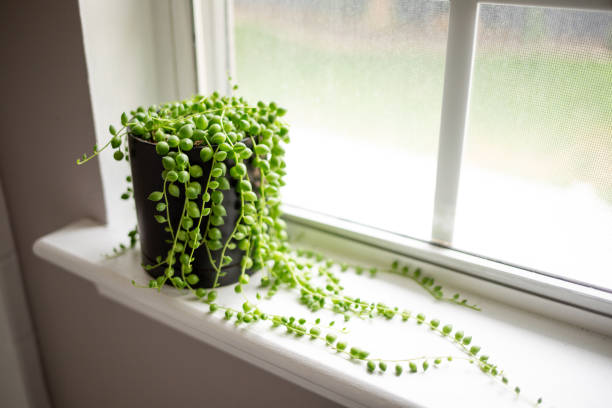
String of Pearls Care Guide for Gulf Gardeners (UAE, Saudi Arabia & beyond)
Low-water, high-impact houseplant? Check. A living necklace that turns heads? Check.
If you live in Dubai, Abu Dhabi, Riyadh, Doha, or anywhere across the Gulf and want
a plant that survives blazing heat, dry AC air, and the occasional missed watering,
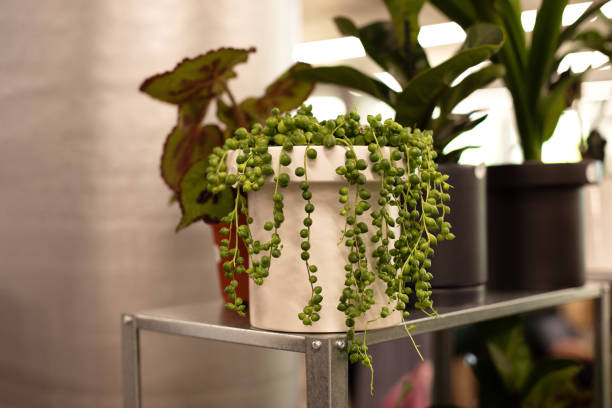
String of Pearls (Curio rowleyanus) is your answer.
This mega-guide walks you through everything—from light, soil and watering
to propagation, pest control, and pet safety—so you can keep those gorgeous green
beads plump all year. Use the quick checklist if you only have 60 seconds, or dive
into each chapter for advanced tips.
⚡ Quick Gulf Grower Checklist
Short on time? Nail these essentials and 90 % of String of Pearls problems vanish:
- Light = 6–8 h bright light. Morning sun + afternoon shade is the sweet spot.
Indoors? Position 50 cm from an east- or west-facing window, or use an LED grow-light. - Soil = cactus mix. Amend with 30 % perlite or pumice for lightning-fast drainage.
Learn more in our Succulent Plants hub. - Pot = terra-cotta with a drainage hole. The clay walls wick away extra moisture.
- Water = “dry-soak-dry”. Drench only when the top 2 cm feel bone dry (≈ 7–14 days).
Reduce to once a month in winter. - Temps = 18–27 °C. AC indoors is fine; protect from < 10 °C cold snaps.
Gulf summers? Provide dappled shade on balconies. - Humidity = low. Skip pebble trays—dry air keeps rot away.
- Feed = half-strength succulent fertilizer every 4–6 weeks (Mar–Sep).
No food in dormancy (Oct–Feb). - Propagate yearly from stem cuttings to keep vines youthful.
How-to in Propagation Masterclass.
1 – Plant Biology & Fun Facts
1.1 Origin Story
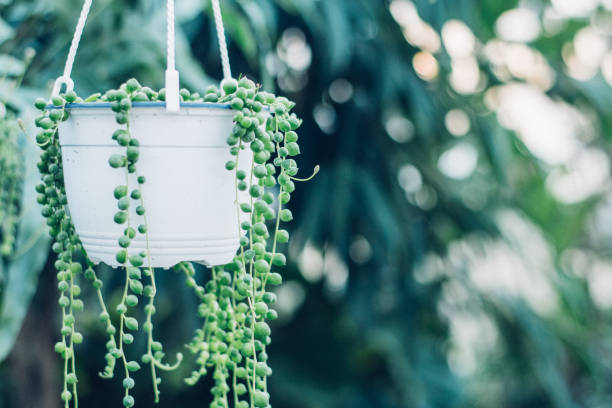
Native to southwest Africa, String of Pearls sprawls across the desert floor,
rooting wherever its bead-laden vines touch soil. Each globe-shaped leaf is a
mini water reservoir—an ingenious adaptation for long droughts. In 1999 taxonomists
moved it from the genus Senecio to Curio, but gardeners still call it by its old
nicknames: string of beads, rosary vine, pearl plant and even “green peas on a
string.” The Royal Horticultural Society lists it as a tender cascading succulent
and awards it the prestigious AGM for ornamental value.
1.2 What Makes Those Beads so Fascinating?
- Tiny windows: Each “pearl” has a translucent slit called an epidermal window
that lets light deep into the leaf for photosynthesis—nature’s solar panel. - Cinnamon blooms: In late spring the plant releases snow-white,
daisy-like flowers with a warm cinnamon-vanilla scent—but only if it gets a
cool (10–15 °C) dry rest in winter. - Fast grower: In ideal Gulf interiors, vines can extend 12–15 cm per year,
quickly filling a 25 cm hanging basket.
1.3 Why Gulf Residents Love It
Life in the Arabian Peninsula means 45 °C summer highs, desalinated tap water,
and year-round AC. Many lush tropical houseplants struggle—but String of Pearls
thrives in the same conditions that flummox ferns and Calatheas.
Add its tiny footprint (it trails instead of spreading), and it’s perfect for
high-rise flats or majlis shelves. For more Gulf-adapted greenery, explore our
guide to Indoor Hanging Plants.
2 – Create the Perfect Gulf Home Environment
2.1 Dial in the Light
Rule #1: 6–8 hours of bright light = plump pearls. In the Gulf, sun
can be intense: place the pot where it catches gentle morning rays (east window)
and indirect afternoon light. Balcony growers should add a 50 % shade cloth or
move the plant 50 cm back from the railing. Gulf News horticulturists advise
similar tweaks for succulents during peak summer.
Troubleshooting Light
- Beads bleaching pale green? Too much direct sun → shift farther from the pane.
- Leggy, sparse nodes? Too little light → add a 30 W full-spectrum grow bulb
for 8 h daily.
2.2 Craft a Drain-Fast Soil Mix
String of Pearls abhors “wet feet.” Blend:
2 parts commercial cactus mix + 1 part coarse perlite or pumice + 1 part washed
river sand.
The pumice keeps micro-air pockets open, letting oxygen reach roots even after
deep watering. For extra protection against Gulf humidity spikes, top-dress
with 1 cm horticultural grit.
2.3 Water Like a Pro
| Season | Indoors (AC) | Balcony / Garden |
|---|---|---|
| Mar–May | Every 10–14 days | Every 7–10 days |
| Jun–Aug | Every 7–10 days | Every 5–7 days (am only) |
| Sep–Oct | Every 10–14 days | Every 10 days |
| Nov–Feb (dormant) | Every 25–30 days | Every 20–25 days |
Always water deeply until it drips from the drainage hole, then discard
run-off. Let soil dry fully before the next soak. Flattening beads tell you the
plant is thirsty; mushy, translucent beads = over-watered.
2.4 Temperature & Humidity Hacks
- Ideal growth zone = 18–27 °C.
- Short cool-down (10–15 °C) from Dec–Feb encourages flowering.
- Relative humidity 30–50 % is perfect. If yours exceeds 60 %, run a small
desk fan for air circulation.
2.5 Fertilizer Schedule
Feed sparingly: half-strength balanced liquid fertilizer (e.g., 20-20-20) every
six weeks from March to September. Too much nitrogen stretches vines and dulls
leaf windows. Skip fertilizer entirely in dormancy.
3 – Year-Round Care Calendar
3.1 Spring (Mar–May)
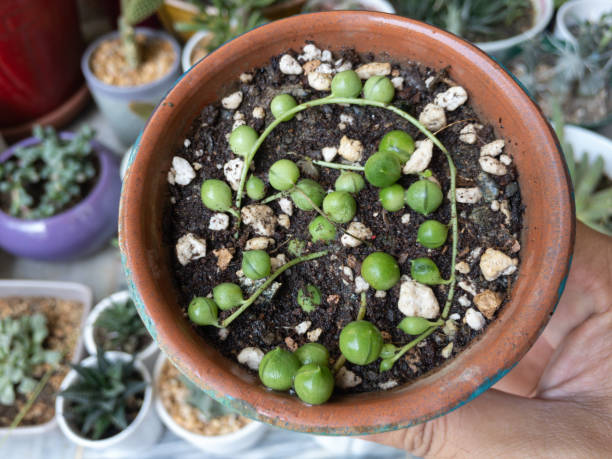
- Re-pot if roots circle the pot or soil has compacted (usually every
2–3 years). Use a container only 2–3 cm wider. - Resume feeding at half strength.
- Light boost: Move plant closer to windowsill as sun angle softens.
- Propagation: Take fresh cuttings now; growth hormones peak in spring.
3.2 Summer (Jun–Aug)
- Shade cloth or sheer curtains filter harsh midday UV.
- Check soil twice a week; AC can dry pots faster.
- Pest patrol: Heat draws aphids and spider mites—see defense tactics
in Section 5.
3.3 Autumn (Sep–Oct)
- Scale back watering as temps cool.
- Light audit: Days shorten; slide plant closer to light source or
increase grow-light hours. - Last feed of the year in early October.
3.4 Winter Rest (Nov–Feb)
- Cool & dry: 10–15 °C room (garage, stairwell) + minimal watering
triggers bloom buds. - No fertilizer.
- Inspect vines monthly; trim any dead beads.
4 – Propagation & Pruning Masterclass
4.1 Why Propagate Every Year?
Unlike woody shrubs, String of Pearls vines thin out with age. Annual propagation
ensures a forever-lush display and gives you free plants for friends.
4.2 3 Propagation Methods (Choose One)
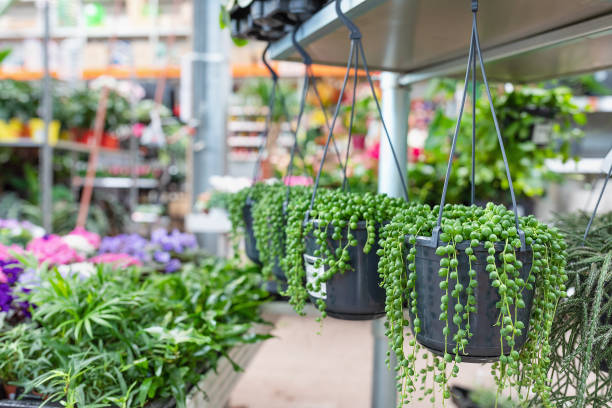
- Soil cuttings (best for beginners)
- Snip 10 cm of healthy vine below a leaf node.
- Strip bottom 3 beads to expose nodes.
- Let callus 24 h, then coil cutting on moist cactus mix.
Press nodes gently into soil. - Mist lightly every 3 days; rootlets appear in 3–4 weeks.
- Water rooting (visual, but slower)
- Place 8 cm cutting in a jar of distilled water; keep nodes above water.
- Change water every 4 days to dodge bacteria.
- Pot into soil when white roots reach 2 cm.
- Layering (minimal fuss)
- Leave vine attached; coil a section onto adjacent soil surface.
- Pin with a hairpin; roots form in 2 weeks. Sever new plant when established.
4.3 Pruning for Fullness
After bloom season, sanitize shears with isopropyl and trim:
- Dead, shriveled beads (improves airflow).
- Leggy strands > 40 cm (stimulates side-shoots).
- Rotten sections (cut 2 cm into healthy tissue).
For more precision techniques, browse our in-depth Pruning Tips.
4.4 Seed Growing (Advanced)
You’ll need hand-pollinated flowers and patience—germination can take 8–12 weeks
and viability is unpredictable. Sow on sterile cactus mix, keep at 24 °C and
60 % humidity, and never let the substrate dry. This method is usually reserved
for breeders rather than casual growers.
5 – Troubleshooting & Pest Defense
5.1 Common Symptoms & Fixes
| Symptom | Likely Cause | Solution |
|---|---|---|
| Shriveled beads | Under-watered | Deep soak; review schedule |
| Flat, translucent beads | Over-watered | Stop watering 2 weeks; repot into dry mix if rot smells |
| Bleached spots | Sunburn | Move 50 cm from glass; add sheer curtain |
| Leggy gaps | Low light | Add grow light / prune & re-root |
| Yellow beads with white fluff | Mealybugs | Q-tip alcohol dab, then neem spray weekly |
5.2 Pest ID & Organic Control
Healthy pearls repel bugs, but stressed plants invite sap-suckers:
- Aphids & Whiteflies → sticky residue on beads. Rinse under lukewarm water,
then spray neem-oil solution every 5 days for 3 weeks. - Spider Mites → fine webbing on nodes. Increase airflow; wipe leaves with
insecticidal soap. - Fungus Gnats → tiny flies, soggy soil. Let soil dry; top-dress with sand;
use yellow sticky traps.
Skip harsh systemic pesticides indoors; organic methods work and are safer for
pets and children.
6 – Toxicity & Pet Safety
Important: All parts of String of Pearls contain pyrrolizidine
alkaloids. Ingestion can trigger vomiting or diarrhea in cats, dogs and humans;
sap may irritate skin. Display plants out of reach and wear gloves when pruning.
For non-toxic alternatives, check our guide to Pet-Safe Gardening.
7 – Frequently Asked Questions
1. Why are my vines thin and sparse?
Likely low light. Move closer to sun or add a grow light and prune to trigger
branching.
2. Can I grow String of Pearls outdoors in Dubai?
Yes—if shaded from intense midday sun (use 50 % shade cloth) and planted in a
raised, sandy bed with zero overhead irrigation.
3. Is desalinated tap water safe?
Generally yes, but high salts can accumulate. Flush soil with distilled water
every 3 months.
4. How do I encourage blooms?
Give a cool, dry rest (10–15 °C) Nov–Feb, bright spring light, and light feeding.
Flowers open mid-spring and smell like cinnamon.
5. Does String of Pearls clean indoor air?
All green plants photosynthesize and absorb some VOCs, but no peer-reviewed
study singles out this species as exceptional. Choose it for beauty, not
air-purification.
6. Why do beads turn brown at the soil line?
Constant contact with wet soil—top-dress with grit and water less frequently.
7. Best pot size for a starter cutting?
7–9 cm nursery pot; too much soil around tiny roots invites rot.
8. Can I bottom-water?
Yes, once vines are established. Let the pot wick for 10 min, then drain.
9. Which grow-light spectrum?
Full-spectrum LED (400–700 nm) at 20–30 cm distance, 8–10 h daily.
10. Why do older beads split?
Overwatering + sudden intense sun. Adjust watering and acclimate gradually to
brighter light.
8 – Further Resources & References
- RHS Plant Profile: Curio rowleyanus
- The Spruce – How to Grow & Care for String of Pearls
- Gardening Know How – Propagating String of Pearls
- Gulf News – Summer Plant Tips for UAE
- The National – Indoor Plant Care in UAE Heat
9 – Wrapping Up
String of Pearls offers Gulf residents a dramatic, drought-tolerant showpiece
with minimal upkeep. Master the dry-soak-dry rule, chase bright light, and
propagate annually, and you’ll enjoy a cascading curtain of emerald beads for
years. Bookmark this checklist, share it with fellow plant parents, and start
styling your Dubai balcony—or Riyadh office—with this unforgettable succulent.


Leave a Reply