
If you love the smell of magnificent gardenia flowers and can be patient enough to grow this plant, you can choose to grow these plants both indoors and outdoors.
The Gardenia flower of Gardenia Jasminoides is a tropical broadleaf evergreen shrub.
This plant is popular as a houseplant as its blooms tend to smell magnificent.
Moreover, these few natural species tend to be as evocative and memorable as the smell of this coveted plant.
However, if it wasn’t for this scent, few gardeners would want to grow this high-maintained gardenia flower.
You can find it in conservatoires and commercial greenhouses.
Still, if you are up for the challenge, even a few months when the plant blooms is a worthwhile task.
You can plant these flowers outdoors in the spring or fall in the southern United States or along the Pacific Coast.
While some gardeners can purchase mature potted specimens for this purpose as well.
You can choose to grow their seed, and expect to wait for 2 to 3 years before the flowers bloom.
Keep on reading to learn more.
Quick Facts bout Gardenia Flowers
| Common Name | Gardenia, cape jasmine |
| Botanical Name | Gardenia jasminoides |
| Family | Rubiaceae |
| Plant Type | Flowering broadleaf evergreen shrub |
| Mature Size | 5 to 6 feet tall, similar spread |
| Sun Exposure | Part shade |
| Soil Type | Rich, well-drained soil, peat-based potting mix in containers |
| Soil pH | 5.0 to 6.5 (acidic) |
| Bloom Time | Seasonal bloomer |
| Flower Color | White, cream |
| Hardiness Zones | 8 to 11 (USA); often grown as a houseplant |
| Native Area | China, Japan, Taiwan |
| Toxicity | Mildly toxic to pets |
Learn more about Poisonous Plants for Pets here.
Gardenia Flowers: Care
These flowers tend to grow only in USDA zones 8 to 11.
Thus, if you live in cooler climates, you can place them as your houseplants outside in summer in temperatures of 60F and higher.
Moreover, these plants tend to thrive in a planting area that you carefully amend with organic material to achieve rich, acidic soil that drains well.
Gardenia flowers like to stay in light or medium shade in a spot that is not facing any competition from tree roots.
It is important to note that the soil should be covered with a thick layer of mulch that helps to cover weeds and moisture.
A well-tended gardenia will grow compact with deep green leaves.

Furthermore, it can bloom in early spring or early summer, depending on its location.
This plant tends to thrive in daytime temperatures of 75 to 82F so when you grow them indoors, you will need to keep the temperature relatively warm.
For this reason, when you bring outdoor gardenia indoors, do so at night when the temperatures fall below the minimum.
Learn more about Soil Amendments: Improving the Garden Soil here.
Light and Soil Requirments
When you plant gardenia flowers indoors, they will need bright light, but not direct sunlight, particularly during summer.
Therefore, place them in a sunny winder where that afternoon shade is best.
While garden gardenia will grow best when you plant them in a shaded location.
Some sun and afternoon shade will work well here as well.
It is important to note that this plant is one of the acid-loving plants, that prefer soil with a lower pH.
Moreover, traditional potting mixes that contain a peat base will meet this criterion.
When you plant them outdoors, it is often a good idea to test the pH of the soil and amend it as needed.
A teaspoon of agricultural sulfur mix into the planting hole can help lower soil pH.
Water, Temperature, and Other Requirments
Gardenia flower tends to prefer an inch of water every week either by rain o by hand.
While drip irrigation also works best as it will keep the water off the leaves, which can cause fungal leaf spots.
Moreover, you should reduce watering in the winter and only keep the soil slightly moist to the touch.
The winter watering method also works well if you are growing this plant in pots.
This plant will need temperatures above 60F, free of cold drafts.
Gardenia also prefers a high humidity level, above 60%.
While indoors plants will need you to use a humidifier or constant misting during a cold, dry winter to maintain humidity.
You will need to feed garden gardenias in mid-March and then again in Late June.
Make sure to use an acid-rich fertilizer. You should always refer to the instructed amounts of the product and mix the fertilizer either directly into the soil.
Or you can dilute it will water.
Moreover, it is best to use slightly under the recommended dosage to avoid over-fertilizations.
It is important to note that you should stop feeding your plant during the fall to stop or inhibit new growth before dormancy.
On the other hand, you can feed container plants every three weeks with an acidifying fertilizer just like the one you use on azaleas or camellias.
While if you are an organic gardener prefer blood meal, fish emulsion, or bone meal.
Furthermore, you can also refer to product recommendations on amounts and test the soil pH regularly.
Types of Gardenias
You can see this plant is widely cultivated in warm climates.
A lot of varieties are created from plant grafting onto the Gardenia thunbergia rootstock.
In this way, the plant tends to grow more vigorously, with larger blooms, however, they are less tolerant to cold than undrafted species.
Some recommended varieties are:
Gardenia jasminoides ‘Aimee’
This one can grow to about 6 feet in height and bears about 4 to 5-inch wide white flowers.
G. jasminoides ‘Fortuniana’
Also popular as one of the best free-blooming varieties, the large shrub of this cultivator produces about 4-inch blooms all season long.
G. jasminoides ‘Buttons’
This one is a dwarf variety, growing 24 to 30 inches tall, and yields a 2-inch flower.
G. jasminoides ‘Crown Jewel’
Crown Jewel grows in a 3-foot-tall compact mound and will bear a 3-inch flower.
Moreover, this flower is also popular to be hardy as far as zone 6.
Pruning and Propagating Tips and Techniques
Remove straggly branches and spend blooms to your liking, prune your gardenia flowers after they stop blooming.
These plants do not need to be pruned every season.
However, this variety tends to perform well with an every-other-year cutback.
When pruning, make sure you are using garden shears to shape back both the green and brown wood.
Moreover, these plants will set buds on both new and old wood, so cutting either of them is fine.
On the other hand, you can propagate this plant with stem cutting in the early spring.
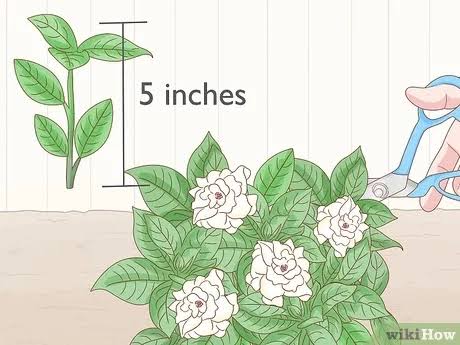
However, most gardeners recommend to propagate them from cuttings that you take during pruning.
Whatever you choose, it is important that you give a new plant enough time to establish roots and grow before winter dormancy.
Propagating gardenia flowers from cuttings is as follows:
- bring garden shears, rooting hormone, 3-inch pots, plastic bags, stakes, and potting soil that contains perlite
- take about a 3 to 5-inch cutting of a stem tip, preferably on green wood, below a leaf node
- remove the lower leaves and leave only the top set of two
- prepare pots with posit potting soil and make a hole into the center of the soil
- dip the cut end of the stem in rooting hormone
- plant the stem into the hole and backfill it
- with plastic bags place them around the pots and prop them with garden stakes
- place your pot in bright, indirect sunlight in a room where the temperature is about 75 F at least
- keep the soil moist until the roots form, it will take about 4 to 8 weeks
- when the temperature is right, transplant the gardenia into your garden
Learn more about Pruning Tips and Techniques here.
Growing Gardenia Flowers from Seeds
Although you can propagate gardenia from seeds, it is a long process that can take about 2 to 3 years before the plant flowers.
To do so, you will need to collect and clean the seeds from dried seed pods.
Then dry them out for three to four weeks in a sunny window.
Plant the seeds in a mixture of perlite and peat moss, barely covering them with 1/8 inch of potting mix.
Moreover, make sure to keep the seeds moist and out of sunlight until they sprout, it will take about 4 to 6 weeks.
When the seedlings are about a few inches tall, transplant them into pots that you will fill with peat-based potting soil.
Continue growing them in a bright indoor location.
Then transplant the seedlings to your garden once they have at least three sets of leaves.
Make sure to care for the baby plants until they reach maturity.
Potting and Repotting your Plant
When you plant gardenias into a container, these plants will prefer high-quality, pet baed potting mix with a low pH.
This can be the one just like the one you can use for rhododendrons.
You can repot gardenias in the spring as needed when they begin to come out of winter dormancy.

Moreover, make sure to find if your plant needs repotting by checking to see if it is root bound, i.e. root may be sticking out of the soil.
You can also repot your plant if it looks less vibrant but has no insects or diseases.
Make sure to always step up your pot size and use a natural stone or terra cotta pot.
This is because both these materials will allow moisture to evaporate through the porous walls.
Overwinter Gardenia Flowers
As this plant is a tropical plant, it cannot tolerate temperatures that go down below 15 F and will also have a hard time dealing with winter frost.
While USDA zones 7 through 10 often do not experience this kind of weather, it is still a good idea that makes sure that your plant is around warm areas.
To do this, you can provide enough layers of mulch to the base of the plant that insulates its roots.
Moreover, you can also create a frost blanket on the night that you suspect a temperature drop-in.
You can purchase a frost cloth at any nursery, or you can use a cardboard box, a bedsheet, or a 5-gallon bucket for this purpose.
Common Pests, Plant Diseases, and Common Problems
Insects, particularly scales, aphids, spider mites, mealybugs, and whiteflies can affect gardenia.
To control bugs, you can use different horticulture oils and soaps as well as organic products.
Whatever you choose, you should arm yourself ahead of time for frequent infestations.
These plants can also suffer from powdery mildew, leaf spot, dieback anthracnose, and sooty mold.
You can treat some of these with fungicides.
In most cases, however, you will need to remove and destroy the affected plant, making them best suited if you enjoy the challenge of providing just the right conditions to deter most diseases.

Moreover, cold temperatures, inconsistent watering, poor soil drainage, and insufficient light can cause bud and leaf drop.
Unsuitable environmental conditions can also lead to the yellowing of leaves.
Any stress on the plant can open the door for pests, fungi, and diseases to move in.
Therefore, it is important to maintain ideal conditions for this plant.
Unless you live in a climate that can help the plant to achieve perfect harmony, you can forego the beautiful gardenia for something more easy-going plant.
How to Get Gardenia to Bloom
To maximize the blooming of gardenia flowers, you will need to make sure their growing conditions are spot on.
It is important to use recommended fertilization and watering needs as these are the initial steps to healthy blooms.
Moreover, wait to prune your plant after the last blooms have faded.
In this way, you will not need to cut back any growth on which new buds may form.
Lastly, you can prevent “bud drop” which is a condition that can affect this plant by making sure there are humidity and water levels that are just right.
Make sure they are not too dry and not too moist to make your plant bloom.

Leave a Reply