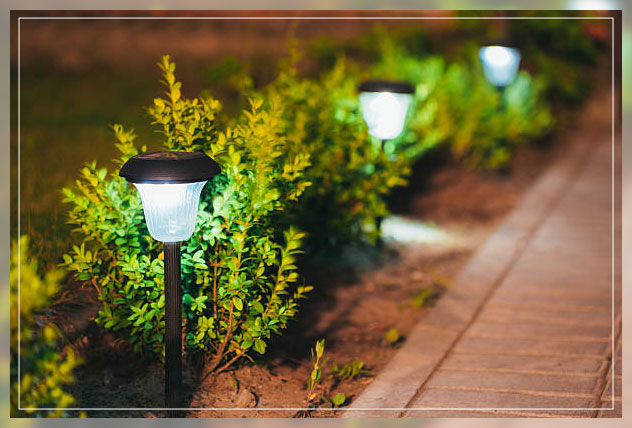
Do you know that solar lights are one of the most efficient breakthroughs in technology?
Moreover, it comes with a number of benefits over conventional lighting methods in your garden.
The new and advanced solar light system includes solar batter, panels, etc, and brings a lot of advantages to the table when you decide to get them for home or outdoor lights.
You can install them in a variety of areas.
Whether you decide to get them for better visibility, spotlights for feature areas, security areas, decorative illumination of patios, or functional markers for pathways, steps, or driveways, solar lights are suitable for every purpose.
Keep on reading to learn more about them.
Solar Lights
In simple words, solar lights emit light obtained from the energy of the sun.
It is one of the most economical and efficient forms of electricity and this is why more people are drawn to the use of these lights.
This has especially increased during the lockdown worldwide.
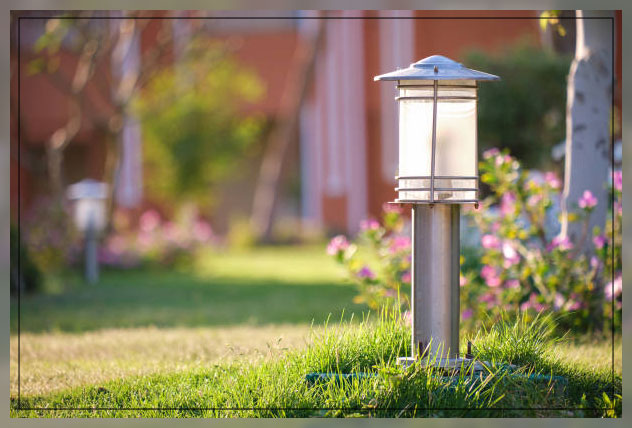
Moreover, this lighting works on the simple principle of collecting energy from the sun and converting it into light.
This process needs the photovoltaic effect that the solar panel makes use of.
The solar panel tends to collect solar energy all day long and is stored in gel-cell solar batteries that are rechargeable.
In this way, you get solar light for your home all throughout the day and night.
Learn more about Fluorescent Lights and Growing Plants here.
Factors to Consider when buying Solar Lights
Before buying solar lights, the following are some factors you should consider;
Type and Brightness
Depending on your purpose, you will have to pick up the right light.
For instance, if you need them for security, you will have basic LED solar lights.
Apart from them, you will also need to consider the brightness of the lights.
It is measured in terms of the lumen and below are general guidelines:
| Solar Lights Type | Brightness Range |
|---|---|
| Step lights | 12 to 100 lumens |
| Landscape solar lights | 50 to 130 lumens |
| Hardscape solar lights (on the wall) | 50 to 185 lumens |
| Path solar lights | 100 to 200 lumens |
| Pond/Pool solar lights | 200 to 400 lumens |
| Motion sensor solar lights | 300 to 900 lumens |
| Flood solar light | 700 to 1300 lumens |
It is important to note that when it comes to solar lights, illuminate very less.
However, as they have small lights, and their use is mostly for decoration, brightness levels do not matter much.
Battery
Batteries in solar lights come in four different types.
These are:
- lithium-ion
- NiMH
- lead acid
- NiCad
Among them, lithium-ion batteries tend to be the popular choice as they have higher capacities and still have a small size.
Solar Panel
These are available in three types: monocrystalline, polycrystalline, and amorphous solar panels.
Among these, monocrystalline solar panels are effective, however, they are a bit expensive.
On the other hand, polycrystalline and amorphous solar panels are less expensive but have less efficiency.
Solar vs. Electric Lights
Installing power lines to have a power source for outdoor electrical lighting is rarely straightforward.
In most cases, running the power lines can disrupt and ruin every garden you are trying to enhance.
The installation will need to be done by a qualified electrician which often proves to be expensive, then there will be ongoing costs and level of maintenance.
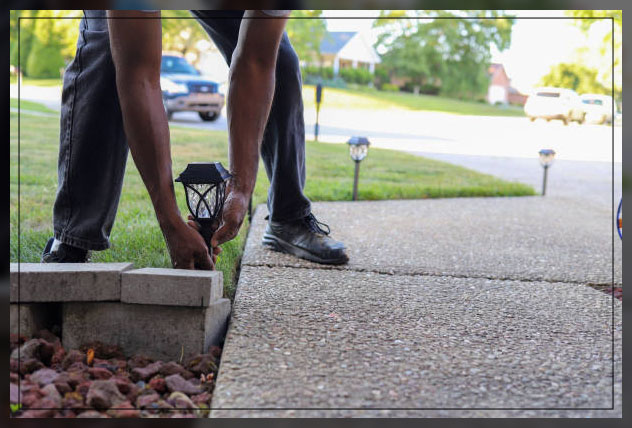
You will need to keep an outdoor electrical system running effectively and most importantly safely.
Though it is no wonder that the sales of solar lights have increased in recent years.
Consumers are opting for a greener, cheaper, and more efficient way of lighting up their gardens.
With no power lines to run, less or no energy bills to contend with, and reliable illumination, it does not take a genius to see why solar garden lights are becoming increasingly popular day by day.
Learn more about Outdoor Light: 9 Ideas you can try Today here.
Working of Solar Lights
The steps below explain how solar lights work:
Panel receives energy from the Sun
During the day, the solar panel that attaches to your garden light will receive energy from the sun.
The photovoltaic cells in the panel will absorb the energy from sunlight.
Panel converts the Solar Energy into Electricity
The energy that photovoltaic cells absorb in the panel helps to create electrical changes.
These charges move in response to an electrical field in the cells of the solar panel which causes electricity to flow.
Electrical Power charges the batteries
The photovoltaic cells contain wires that directly go to the batteries.
Moreover, in electricity begins to flow, the batteries of the panel will change and store the electrical power.
This way, the yard light with have power stored when sunlight is no longer there.
Batteries activate at Night Time
It is important to note that every solar light tends to have a controller with a photoresistor.
A photoresistor detects when there is little or no light from the sun.
Furthermore, at night, the controller of the solar panel cannot detect the sunlight. When this occurs, the controller will automatically activate the batteries.
Light switches On
When the controller of the solar panel activates the batteries, the electrical power releases, and the light switches on.
Most solar string lights can operate for up to 15 hours when they are fully changed.
Advantages of Solar Lights
You can get a number of advantages for choosing solar lights over traditional lights.
Some key benefits of solar lights for home are:
Eco-friendliness
Experts press on that these light systems come with great environmental benefits.
The solar panels will need absolutely no power from the grid and the batteries fed on the sunlight all day and illuminate the area at night.
Moreover, it is a renewable form of light and energy and there is absolutely no reason to worry about running out of light as the sun will always rise.
Therefore, you will be able to minimize your carbon footprint and reduce pollution.
Cost-Effective
Though it costs a bit of money to buy solar lights or when installing solar panels, the initial investment pays for itself across posterity.
Adding solar lights to your property and you will not have to pay bills of electricity necessary to keep your space well-lit.
Low Maintenance Cost
The outdoor light system for your home will need very little maintenance.
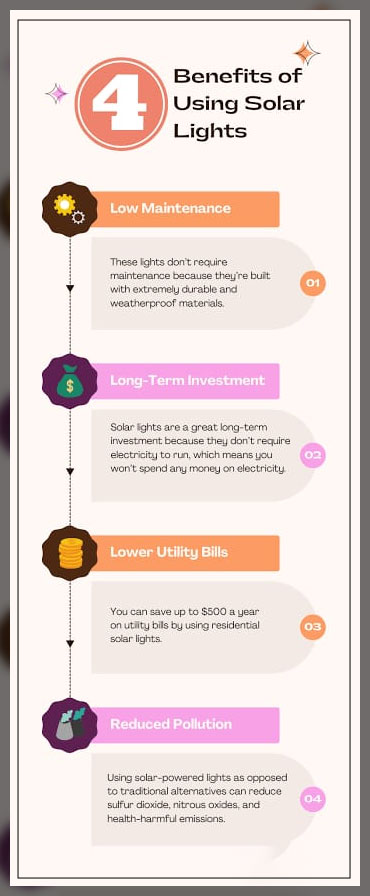
Though the upfront cost or the installation cost is relatively higher, these lights will pay for themselves over time.
Moreover, they will last for a long time and do not require a lot of services.
Great Mobility
There is no need to run any cords or wires when you move the solar-powered lights.
You will need to provide them with a steady source of power without cords in a way that poses a tripping hazard.
It does not get any easier than that.
More Diverse
It is important to note that there are a number of types of solar lights available in the market.
Whether you are looking for solar lights of a specific size or style, you can easily find them.
Also, whether you want to illuminate a walkway in your front yard or a large part of your backyard, you will find a number of solar light options.
Learn more about Garden Lighting here.
Light Options
Now that you know about solar lights, you can select options.
Apart from the difference in bulbs and mounting, there is also the intensity and longevity of the light.
Brighter lights will take more light. More lights tend to have a high and low setting to meter power usage.
However, you will need to change the high and low settings manually.
As demand for smarter lights is growing, options for light that stay bright for a few hours and then dim to lower settings have become inevitable.
For now, the best way you can illuminate your garden for visibility is by using a variety of lights.
Moreover, different colors and patterns will allow for interesting illumination.
For the brightest pathway solar lights, consider the power-directed spotlight-style units.
These will direct the light with conical fixtures that will provide specific light.
Close to the ground units with a single light directly in the way, and will cascade less light into other places.
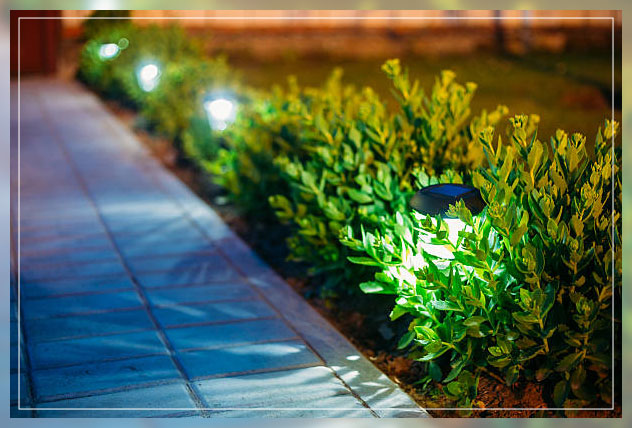
For a more decorative feel, you can choose string lights and imitation lamp posts.
These bright outdoor lights will rise above some of the vegetation so that they get a better charge.
The light these units will produce is more diffuse and will provide a pleasing glow instead of direct illumination.
With delicate plants that line your garden path, overhead diffuse lighting avoids the risk of burning.
This will still provide adequate aid for walking or working.
Bright LEDs adjacent to leafy plants can, however, cause bleaching and curling.
You will need to decide between maximum visibility and practicality in some cases.
With a variety of lights on the market, however, this is not a large concern.
String lights will make good choices for heavily shaded garden areas.
String lights make sure of solar collectors at the anchor points which allows you to avoid shade whether it comes from trees or a large overhang.
Furthermore, string light also provides an excellent way to wire a roof-based solar array into the garden.
Final Thoughts
With solar garden lights, you will not need power cords or labor-intense installation of power cables which can disrupt and spoil every garden you are trying to enhance.
There is a wide range of solar light styles available for your outdoor area which different and varying brightness ranges to illuminate whole pathways or garden features. Therefore, keep in mind the above factors when considering buying solar lights.



Leave a Reply