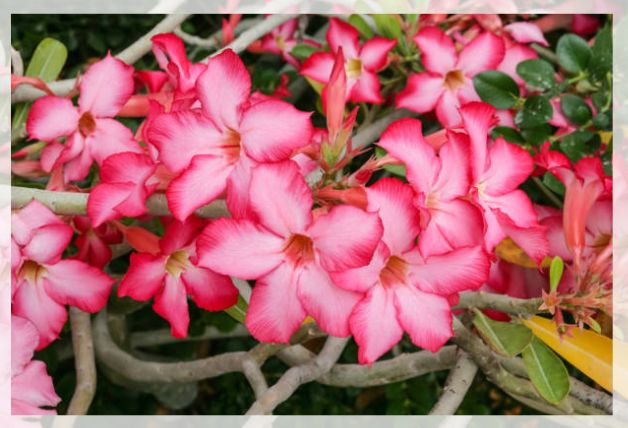
It is easy to fall in love with a swollen woody stem that holds lush blossoms of vibrant pink, coral, and red hues, the Adenium Obesum or desert rose.
There is no denying that these indoor succulents are show-stoppers when you compare them to other potted specimens.
Whether you choose to place them on the patio, in your den, or as your houseplant, these plants make them an excellent addition.
What makes this sun-loving plant more interesting is the amount of care it will need for optimal growth.
The Adenium Obesum or desert rose will need minimal care to maintain its trumpet-shaped colorful flowers for long periods.
Moreover, as long as you keep them at the right temperature, there is no way you can go wrong with these succulents.
Keep on reading to learn more.
Adenium Obesum
The Adenium Obesum, aka desert rose, is a slow-growing plant.
It only grows about 12 inches per year.
Moreover, the desert rose is often used as a bonsai plant thanks to its succulent truck, thin and delicate leaves, and luscious, deep pink trumpeting flowers.
This plant is native to Africa, the Middle East, and Madagascar.
It is important to note that this plant is the only Adenium that is extensively hybridized to get different flower colors.
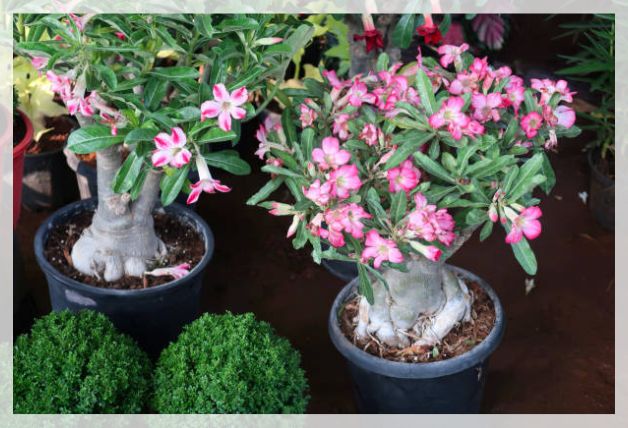
Desert rose in an indoor or outdoor plant depending on the location you are in.
In a number of tropical and warmer climate zones, i.e. USDA zones 11 and 12, it is widely used ornamental outdoor plant.
While in cooler zones, you can grow this plant indoors.
The best time to plant adenium obesum is in the spring and it tends to die if exposed to frost and freezing temperatures.
A member of the dogbane family, the sap of this plant is toxic to both humans and pets.
Quick Facts about Adenium Obesum
Some quick facts about adenium obesum are:
| Common name | Desert rose, Sabi star, mock azalea, impala lily |
| Botanical name | Adenium obesum |
| Family | Apocynaceae |
| Plant type | Succulent |
| Mature size | 3–9 ft. tall, 3–5 ft. wide |
| Sun Exposure | Full |
| Soil type | Sandy, well-drained |
| Soil pH | Neutral to acidic |
| Bloom time | Summer |
| Flower color | Pink, red, rose |
| Hardiness zones | 11-12 (USDA) |
| Native area | Tropical Africa, the Arabian peninsula |
| Toxicity | Toxic to humans and pets |
Adenium Obesum Care
It is simple to take care of adenium obesum, aka desert rose.
However, it will take some finesse.
Just like other succulent plants, it will need careful water management and lots of sunlight.
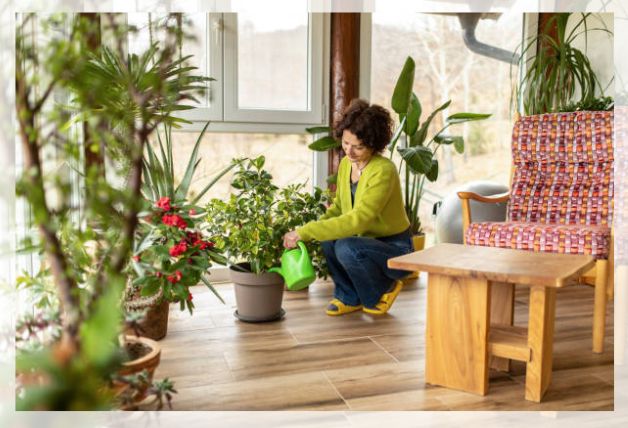
Moreover, the plant also prefers consistently warm temperatures which is why you can grow this plant indoors in many parts of the United States, except for USDA zones 11 and 12.
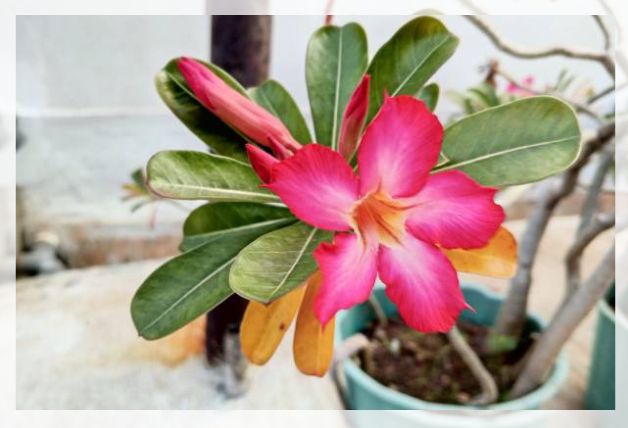
The plant will often bloom during the summer months. erupting with vibrant pink, rose, or red flowers, and bright green leaves.
However, when it goes dormant for the winter season, it drops its flowers and foliage.
Light and Soil Requirements
The desert rose tends to thrive in a full-sun environment.
Thus make sure to choose a spot in your home so that your plant receives enough light throughout the day.
It can be a southern-facing bright windowsill or sunroom of your home.
However, if you live in an area where you can grow this plant successfully outdoors, the best place to plant them is in a spot that is not shaded by taller plants.
Find a place that offers some protection from the high-noon sun, which can scorch the leaves of the plant.
As the name suggests, the desert rose plant acclimates to naturally dry, desert-like conditions.
This means that your plant will need sandy or gravelly cactus soil.
Moreover, the soil should have a neutral to acidic pH ideally hovering right about 6.0.
Water, Temperature, and other requirements
It is important to note that the desert rose plant tends to have varying water requirements depending on the time of year and temperature.
During its growing season, i.e. late spring and summer, make sure to keep the soil moist but never saturated.
Make sure to check the soil periodically, and allow it to dry completely between waterings.
Moreover, plant your desert rose in a container that tends to have enough drainage hole.
This plant can be suspectible to rot if it becomes too moist, so a clay or terra cotta pot can help wick away excess moisture.
During fall and winter months, when the plant goes dormant in the wild, drastically reduces moisture, and water only once a month or so.
If you are, however, curious whether your plant is receiving enough water during its growing season, you can look at the truck for this answer.
A swollen, thick trunk, in proportion to the size of the plant, indicates that it is well-hydrated.
Furthermore, make sure to keep your plant in warm temperatures all the time.
This plant tends to die quickly if you expose it to prolong temperatures cooler than 50 degrees Fahrenheit.
It tends to thrive best at temperatures between 65 and 90 degrees Fahrenheit.
If you plant the desert rose outdoors, it will not survive any prolonged frost.
Humidity is also important as this plant needs a dry, hot climate.
For added dose of nutrients and more flowers, you will need to feed your adenium obesum with liquid fertilizer.
Make sure to dilute it by half and use it once a month during its active growth period.
However, do not fertilize the plant during the dormant period.
Types of Desert Rose
There are a number of types of adenium.
However, the most common and the one you can easily find is Adenium obesum.
Some other subspecies are:
Adenium obesum subsp. oleifolium: This one is native to South Africa and Botswana.
it grows to 16 inches tall with a large, tuberous stem, narrow olive-green blade-like leaves, and salmon, pink, or pale pink with red tubular flowers.
Adenium obesum subsp. socotranum: This one is native to Socotra, an Indian Ocean island between Somalia and Yemen.
Moreover, this is one of the largest species that rises to 15 feet tall with an 8-foot diameter trunk.
Pink flowers are about 5 inches in diameter and appear in spring while the plant is leafless.
Adenium obesum subsp. somalense: This one is native to Eastern Africa and has narrow bladed-like leaves and twisting branches.
It tends to mature at 16 feet tall with a swollen and twisted truck.
Trumpet-shaped flowers are pink, white, or crimson red.
Adenium obesum subsp. swazicum: Also popular by its common name, summer impala lily, is a dwarf species that often does not get larger than 2 feet tall.
It is native to Swaziland and South Africa. Its showy flowers are pink to deep reddish pink.
Pruning and Propagating Tips
Before you prune the desert rose plant, use rubbing alcohol or a bleach solution to sterilize your pruning tools, and re-sterilize as you move from one plant to the next.
Make sure to remove cold-damaged growth as soon as new growth emerges.
Time the long and lanky stems to balance the stem growth symmetrically.
Remove branches that rub or cross other branches, cutting just above a leaf node or where the stem joins another stem.
You can grow desert roses from branch cuttings and seeds.
If you grow this plant from a branch cutting, the next plant might not have the same characteristic bulbous trucks that it would when you propagate from seed.
From stem cuttings, here’s how you do it:
- before you start, have garden gloves, sterilized pruners, rooting hormone, a clean pot, and a well-draining potting mix
- put on gloves to avoid the toxic sap touching your skin
- use pruning snips and take a 5 to 6-inch cutting from the tip of the branch
- allow the cutting to dry out for a day or so
- wet the cut end and dip it in the rooting hormone
- then place into a well-draining growing medium, like perlite or sand mixed with potting soil
- water it daily, however, make sure that the water drains out of the soil
- the cutting will take root in about 2 to 6 weeks
Growing from Seeds
The best time to sow the seeds of the desert rose is in the spring.
You will need to get a well-draining potting mix with perlite or use a sand and soil mix.
You can choose to soak the seeds in advance for a number of hours or up to a day to rehydrate them.
Then place one seed every 2 inches onto the growing medium and cover lightly with a thin layer of soil mix.
Make sure to water thoroughly and keep the plant in a warm location.
Water once the soil begins to dry out.
You can also mist the soil or water the container from below but do not allow the soil to become waterlogged.
Once the seedling sprout, which often happens in a week to 10 days, move the plant container to a sunny spot.
Potting and Repotting Adenium Obesum
You will need to repot the plant as needed, often when the roots fill the container and the plant becomes root-bound.
This can either be once a year or every other year.
However, if you do not want your plant to grow much larger, you can keep it in its current container.
Keeping a plant root-bound will slow down its growth.
The best time to repot your plant is in late winter or early spring, preferably as soon as new growth emerges.
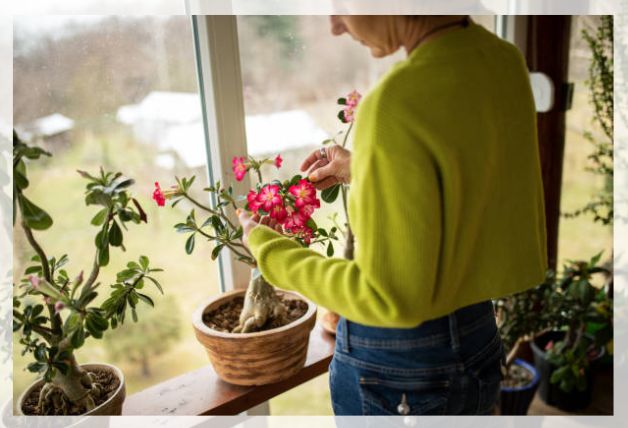
When repotting a succulent, make sure that the soil is completely dry before gently removing the plant from the pot.
Then knock away the old soil from the roots and remove any rotted or dead roots in the process and if you make any cuts or notice bruises, you can apply a fungicide or antibacterial solution topically.
Place the plant in its new plant and then backfill with potting mix, spreading the roots out as you repot.
Let the plant dry for a week or so to reduce the shock to the plant, after a week, water the plant.
But make sure that it drains thoroughly.
Do not let the plant sit in standing water or soggy soil.
Overwintering Tips
Desert rose is unable to endure frost or prolonged cold.
Once the temperature reaches 50 degrees Fahrenheit, the plant will drop its leaves and will trigger its slowed dormant phase.
In order to keep your plant alive, bring it indoors, stop watering, and place it somewhere it will not freeze.
You can put your plant in a garage or basement that remains above freezing.
It will not need care or light until the spring.
Once the warm temperature returns, slowly provide water, place it in the window with a sunny exposure, and gradually reintroduce the plant to outdoor life.
How to get your plant to Bloom?
Desert rose tends to bloom about seven to eight months before sowing.
It often depends on the cultivation condition.
To encourage blooming, make sure that your plant receives at least 6 hours of sunlight and provides fertilizer at least once a month during spring and summer.
If your plant was recently repotted, it may be putting its energy into developing new roots instead of flowers.
Make sure to give it time to adjust to its new growing environment.
Common Problems with Desert Rose
Desert rose is a relative disease and pest-free plant.
However, the biggest problem that affects this plant is overwatering.
When growing conditions are not ideal, it will reduce its natural defenses, and pests or diseases creep in.
Yellowing Leaves or Leaf Drop: A common sign of root rot is yellowing leaves or sudden leaf loss.
A fungus tends to cause root rot and if you catch it early, you may be able to save the plant.
You will need to remove the damaged leaves and stems and unpot the root ball.
Moreover, if you notice any blackened, mushy roots, cut away the damaged ones with a sharp knife.
Between cuts, sterilize your knife. Apply a fungicide, according to package instructions.
Replant the remaining roots in a well-draining potting mix.
Spotting on Leaves: Powdery Mildew tends to leave blister-like marks on the upper lead surfaces.
It can lead to distorted growth and a white powdery-looking substance on the leaves, stems, and buds of the plant.
This can spread more often during cool, damp nights, and warm days.
It is important to note that powdery mildew does not like water.
Mist the plant leaves and apply a fungicide, prune when the stems and branches bunch up.
Enough spacing between plants tends to reduce the risk of powdery mildew.
Speckling of Lower Leaves: Spider mites tends to be the most common pest to attack this plant.
They tend to feed by sucking sap, primarily from the undersides of the leaves.
Moreover, leaf speckling leads to complete discoloration and eventually leaf death.
to identify spider mites, shake the infected foliage over a piece of white paper, spider mites tend to look like small dots.
You will also notice fine webbing and eggs on the undersides of the leaves.
To get rid of a small infestation, use a forceful spray of water on the underside of the leaves.
make sure to repeat this every several days. You can use insecticidal soap or neem oil for mite control.
Make sure to apply it to the underside of the leaves and all the lower surfaces of the plant.



Leave a Reply